Search This Blog

Showing posts with label biochemistry. Show all posts

Wednesday, September 18, 2013

In Water as In Love, Likes Can Attract


Golfsmith.com


SEPTEMBER 18, 2013
Lynn Yarris (510) 486-5375  lcyarris@lbl.gov
 0 


Science Short
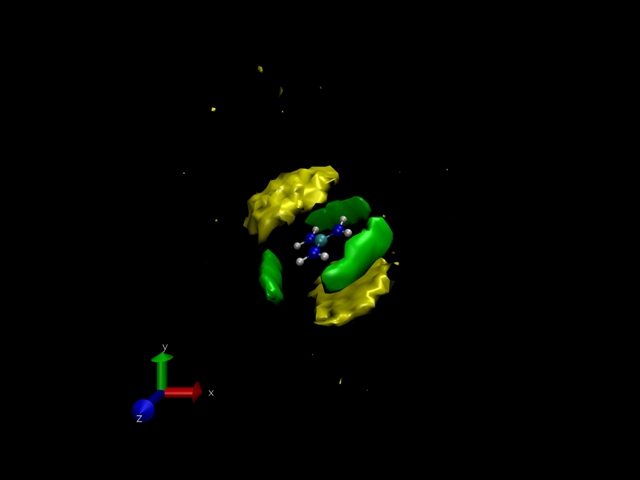
This model of the guanidinium chloride salt in solution shows  carbon (yellow) and water (green) surrounding the cations and  demonstrates cation-cation pairing.
This model of the guanidinium chloride salt (blue and silver) in solution shows carbon (yellow) and water (green) surrounding the cations and demonstrates cation-cation pairing.
At some point in elementary school you were shown that opposite charges attract and like charges repel. This is a universal scientific truth – except when it isn’t. A research team led by Berkeley Lab chemist Richard Saykally and theorist David Prendergast, working at the Advanced Light Source (ALS), has shown that, when hydrated in water, positively charged ions (cations) can actually pair up with one another.
“Through a combination of X-ray spectroscopy, liquid microjets and first principles’ theory, we’ve observed and characterized contact pairing between guanidinium cations in aqueous solution,” Saykally says. “Theorists have predicted this cation-to-cation pairing but it has never been definitively observed before. If guanidinium cations can pair this way, then other similar cation systems probably can too.”
Guanidinium is an ionic compound of hydrogen, nitrogen and carbon atoms whose salt – guanidinium chloride – is widely used by scientists to denature proteins for protein-folding studies. This practice dates back to the late 19th century when the Czech scientist Franz Hofmeister observed that cations such as guanidinium can pair with anions (negatively charged ions) in proteins to cause them to precipitate. The Hofmeister effect, which ranks ions on their ability to “salt-out” proteins, became a staple of protein research even though its mechanism has never been fully understood.
In 2006, Kim Collins of the University of Maryland proposed a “Law of Matching Water Affinities” to help explain “Hofmeister effects”. Collins’s proposal holds that the tendency of a cation and anion to form a contact pair is governed by how closely their hydration energies match, meaning how strongly the ions hold onto molecules of water. Saykally, who is a faculty scientist in Berkeley Lab’s Chemical Sciences Division and a professor of chemistry at the University of California Berkeley, devised a means of studying both the Law of Matching Water Affinities and Hofmeister effects. In 2000, he and his group incorporated liquid microjet technology into the high-vacuum experimental environment of ALS beamlines and used the combination to perform the first X-ray absorption spectroscopy measurements on liquid samples. This technique has since become a widely used research practice.
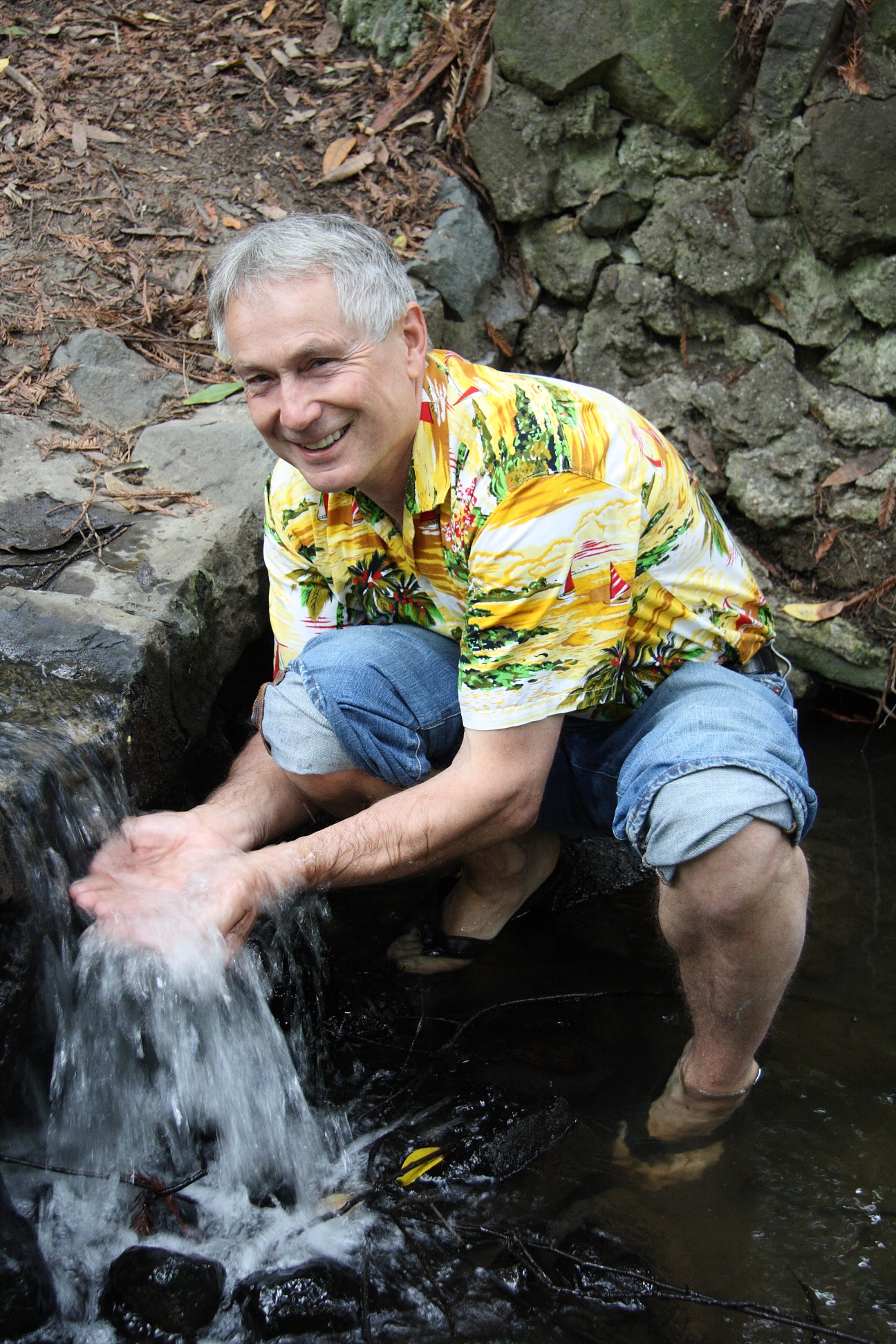
Berkeley Lab’s Rich Saykally has spent much of his career investigating the amazing chemistry of water.
“The XAS spectrum is generally sensitive to the changes in the local solvation environment around each atom, including potential effects of ion-pairing,” Saykally says. “However, the chemical information that one can extract from such experimental data alone is limited, so we interpret our spectra with a combination of molecular dynamics simulations and a first principles theory method.”
Development of this first principles theory method was led by Prendergast, a staff scientist in the Theory of Nanostructures Facility at Berkeley Lab’s Molecular Foundry. Computational resources were provided by the National Energy Research Scientific Computing Center (NERSC). The Molecular Foundry and NERSC, as well as the ALS, are all U.S. Department of Energy national user facilities hosted at Berkeley Lab.
With the liquid microjet technology, a sample rapidly flows through a fused silica capillary shaped to a finely tipped nozzle with an opening only a few micrometers in diameter. The resulting liquid beam travels a few centimeters in a vacuum chamber and is intersected by an X-ray beam then collected and condensed out. In analyzing their current results, which were obtained at ALS Beamline 8.0.1, the Berkeley Lab researchers concluded that the counterintuitive cation-cation pairing observed is driven by water-binding energy, as predicted by theory.
Orion Shih, a recent graduate of Saykally’s research group, is the lead author of a paper describing this study in the Journal of Chemical Physics. The paper is titled “Cation-cation contact pairing in water: Guanidinium.” Saykally is the corresponding author. Other co-authors are Alice England, Gregory Dallinger, Jacob  Smith, Kaitlin Duffey, Ronald Cohen and Prendergast.
“We found that the guanidinium ions form strong donor hydrogen bonds in the plane of the molecule, but weak acceptor hydrogen bonds with the pi electrons orthogonal to the plane,” Shih says. “When fluctuations bring the solvated ions near each other, the van der Waals attraction between the pi electron clouds squeezes out the weakly held water molecules, which move into the bulk solution and form much stronger hydrogen bonds with other water molecules. This release of the weakly interacting water molecules results in contact pairing between the guanidinium cations. We believe our observations may set a general precedent in which like charges attract becomes a new paradigm for aqueous solutions.”

Friday, June 14, 2013

Biological Soil Crust Secrets Uncovered


Berkeley Lab Team Reveals How Desert Cyanobacteria Awaken to Rainfall Then Resume Their Sleep

JUNE 14, 2013
Lynn Yarris (510) 486-5375  lcyarris@lbl.gov
 14 


Feature
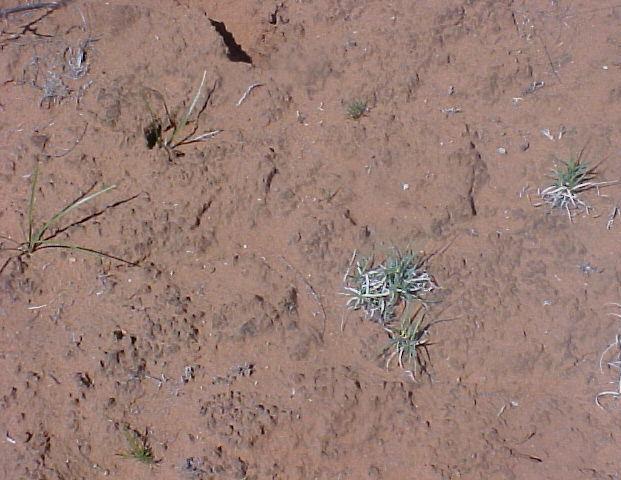
This looks like ordinary dirt but it is a biological soil crust (BSC), a living mantle of soil particles bound together by microbes and their by-products. BSCs are common to the arid and semiarid lands that make up about 40-percent of Earth’s total land mass. (Photo from Ferran Garcia-Pichel)
They lie dormant for years, but at the first sign of favorable conditions they awaken. This sounds like the tagline for a science fiction movie, but it describes the amazing life-cycles of microbial organisms that form the biological soil crusts (BSCs) of Earth’s deserts. Now a research team with the U.S. Department of Energy (DOE)’s Lawrence Berkeley National Laboratory (Berkeley Lab) has reported a unique molecular-level analysis of a BSC cyanobacterium responding to the wetting and drying of its environment. The results hold implications for land management, improved climate change models, and a better understanding of carbon cycling in soil microbial communities and how changes in global temperatures impact Earth’s deserts.
“We found a way to measure from start to finish in real unaltered samples the molecular events behind the response of cyanobacterium to wetting and drying in a desert BSC,” says Aindrila Mukhopadhyay, a biologist with Berkeley Lab’s Physical Biosciences Division. “Not only did we get a good view of the genetic machinery that wakes the microbes up, but we also got a good sense of what constitutes a healthy BSC.”
Mukhopadhyay and Trent Northen, a chemist with Berkeley Lab’s Life Sciences Division, are the corresponding authors of a paper describing this research in the journal of the International Society for Microbial Ecology. The paper is titled “Dynamic cyanobacterial response to hydration and dehydration in a desert biological soil crust.”
Arid and semi-arid deserts make up about 40-percent of Earth’s total land mass. Much of the undisturbed soil crust in these deserts is a living mantle of microbes and their by-products, with the predominant inhabitants being cyanobacteria, microorganisms that use photosynthesis for energy. To survive dry spells that can go on for years, BSC microorganisms must enter a dormant state but they must also be poised for rapid resuscitation to utilize short periods of precipitation. For a better understanding of how the microbes are able to do this, the Berkeley Lab research team studied the cyanobacteriumMicrocoleus vaginatus.
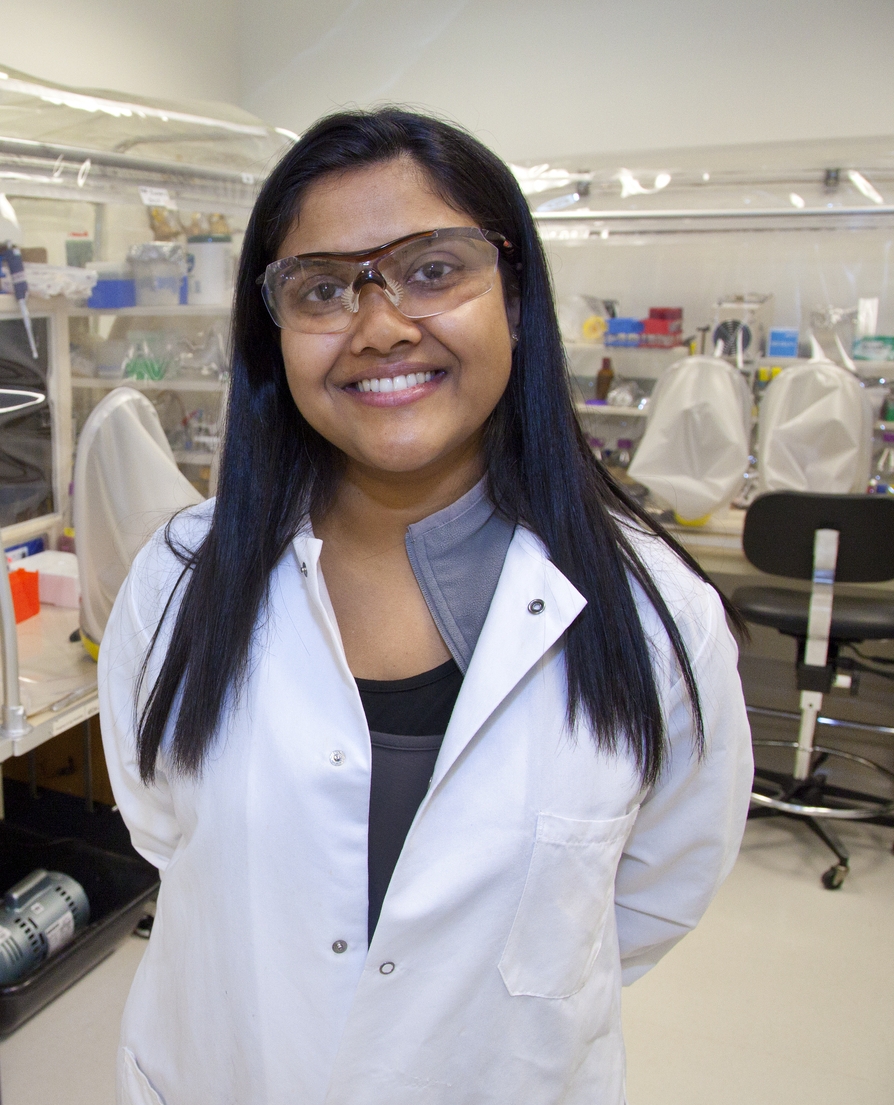
Aindrila Mukhopadhyay is a biologist with Berkeley Lab’s Physical Biosciences Division (Photo by Roy Kaltschmidt)
“M. vaginatus is the early BSC colonizer, an ecosystem pioneer that fixes carbon and binds the soil together allowing the community to develop while preventing wind erosion,” says Northen. “It is globally distributed in regions where water is scarce, including not only hot deserts but the arctic as well.”
Working with the research group of Ferran Garcia-Pichel at Arizona State University, the Berkeley Lab team collected pie-sized samples of soil crust from the cold desert area near Moab, Utah. These samples were subjected to in situwetting and drying over a period of six days, including two diel (day/night) cycles. The wetting simulated conditions that would be brought about by the passage of a rain front. During the study, the researchers performed whole-genome transcriptional analysis and precise biochemical measurements.
“Simulated weather conditions and sampling in a temporal manner over the six day experimental period allowed us to track key transcriptional and metabolic responses as they occurred,” says Mukhopadhyay. “We found that within three minutes after wetting began, metabolic processes in the dormant microbial cells came alive. Within one hour, photosynthesis began, accompanied by carbon dioxide up-take. During this time we saw specific genes get turned on/off and specific gene expressions be elevated or depressed.”
The rain episode lasted three days. Although rare, such conditions do occur in the desert and enabled the researchers to differentiate between wetting-up and drying-down responses from diel cycle responses. They discovered that when dehydration of the soil resumed, the mechanisms triggered by wetting were mirrored in the reverse direction, suggesting that the M. vaginatus microbes were preparing themselves to re-enter desiccation-induced dormancy.
“These BSC microbes are highly attuned to their environment and they respond very quickly to changes,” Mukhopadhyay says. “Their responses, however, are highly sensitive to physical disturbances and alterations in temperature.”
In their paper, the Berkeley Lab researchers say that a better understanding of how environmental factors influence the growth and metabolism of M. vaginatus and other BSC microbes should improve our ability to predict the impacts of climate or land-use change on BSC systems. This knowledge should also help in the development of management strategies for restoring BSCs following large-scale disturbances.
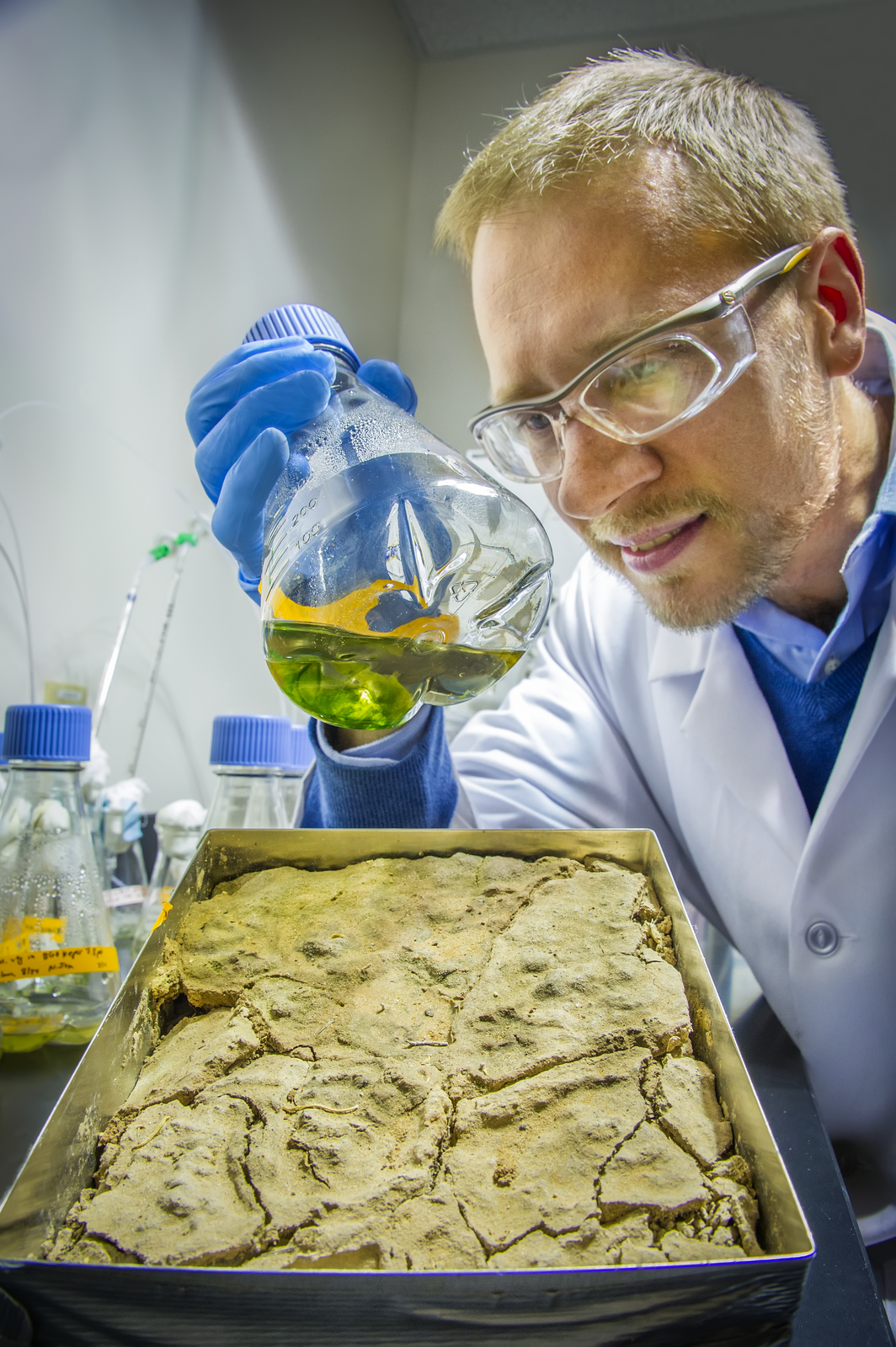
Trent Northen is a chemist with Berkeley Lab’s Life Sciences Division (Photo by Roy Kaltschmidt)
“BSC systems represent the world’s largest biofilms, and the demise of such systems could release carbon, and probably more importantly, dust into the atmosphere, changing the albedo of snow-packs,” says Northen. “Restoring or protecting BSCs through changes in land-use could help pull carbon out of the atmosphere and reduce dust.”
A better understanding of BSCs could also deepen our understanding of the carbon cycle, which could improve the accuracy of climate models, as Mukhopadhyay explains.
“In most climate models there is little or no accounting for the carbon fixed by soil microbes,” she says. “BSC cyanobacteria are the photosynthetic organism for deserts and understanding their role in the carbon-cycle will help fill in current climate model gaps. This should help improve the accuracy of these models.”
The Berkeley Lab team would like to expand their efforts to examine other BSC systems around the world. Among other issues, they would like to identify the signaling mechanisms that inform dormant BSC microbes that moisture is present or that the temperature is changing and it is time to respond.
“BSCs are sentinels for marking the health or decline of the world’s deserts, one of Earth’s major ecosystems,” Mukhopadhyay says. “It is vital that we understand them.”
Co-authoring the paper “Dynamic cyanobacterial response to hydration and dehydration in a desert biological soil crust” were Lara Rajeev, Ulisses Nunes da Rocha, Niels Klitgord, Eric Luning, Julian Fortney, Seth Axen, Patrick Shih, Nicholas Bouskill, Benjamin Bowen, Cheryl Kerfeld, Ferran Garcia-Pichel and Eoin Brodie.
This research was funded through Berkeley Lab’s Laboratory Directed Research and Development program.
#  #  #
Lawrence Berkeley National Laboratory addresses the world’s most urgent scientific challenges by advancing sustainable energy, protecting human health, creating new materials, and revealing the origin and fate of the universe. Founded in 1931, Berkeley Lab’s scientific expertise has been recognized with 13 Nobel prizes. The University of California manages Berkeley Lab for the U.S. Department of Energy’s Office of Science. For more, visit www.lbl.gov.
DOE’s Office of Science is the single largest supporter of basic research in the physical sciences in the United States, and is working to address some of the most pressing challenges of our time. For more information, please visit the Office of Science website atscience.energy.gov/.
Additional Information
A video of Aindrila Mukhopadhyay discussing aspects of her BSC research can be viewedhere