Search This Blog

Showing posts with label chemistry. Show all posts

Wednesday, September 18, 2013

In Water as In Love, Likes Can Attract


Golfsmith.com


SEPTEMBER 18, 2013
Lynn Yarris (510) 486-5375  lcyarris@lbl.gov
 0 


Science Short
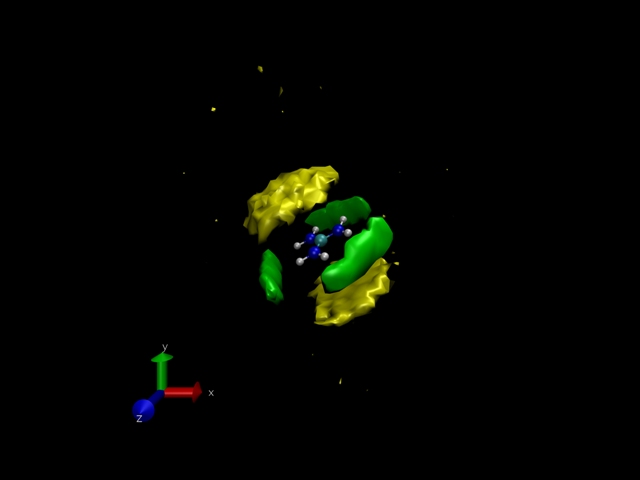
This model of the guanidinium chloride salt in solution shows  carbon (yellow) and water (green) surrounding the cations and  demonstrates cation-cation pairing.
This model of the guanidinium chloride salt (blue and silver) in solution shows carbon (yellow) and water (green) surrounding the cations and demonstrates cation-cation pairing.
At some point in elementary school you were shown that opposite charges attract and like charges repel. This is a universal scientific truth – except when it isn’t. A research team led by Berkeley Lab chemist Richard Saykally and theorist David Prendergast, working at the Advanced Light Source (ALS), has shown that, when hydrated in water, positively charged ions (cations) can actually pair up with one another.
“Through a combination of X-ray spectroscopy, liquid microjets and first principles’ theory, we’ve observed and characterized contact pairing between guanidinium cations in aqueous solution,” Saykally says. “Theorists have predicted this cation-to-cation pairing but it has never been definitively observed before. If guanidinium cations can pair this way, then other similar cation systems probably can too.”
Guanidinium is an ionic compound of hydrogen, nitrogen and carbon atoms whose salt – guanidinium chloride – is widely used by scientists to denature proteins for protein-folding studies. This practice dates back to the late 19th century when the Czech scientist Franz Hofmeister observed that cations such as guanidinium can pair with anions (negatively charged ions) in proteins to cause them to precipitate. The Hofmeister effect, which ranks ions on their ability to “salt-out” proteins, became a staple of protein research even though its mechanism has never been fully understood.
In 2006, Kim Collins of the University of Maryland proposed a “Law of Matching Water Affinities” to help explain “Hofmeister effects”. Collins’s proposal holds that the tendency of a cation and anion to form a contact pair is governed by how closely their hydration energies match, meaning how strongly the ions hold onto molecules of water. Saykally, who is a faculty scientist in Berkeley Lab’s Chemical Sciences Division and a professor of chemistry at the University of California Berkeley, devised a means of studying both the Law of Matching Water Affinities and Hofmeister effects. In 2000, he and his group incorporated liquid microjet technology into the high-vacuum experimental environment of ALS beamlines and used the combination to perform the first X-ray absorption spectroscopy measurements on liquid samples. This technique has since become a widely used research practice.
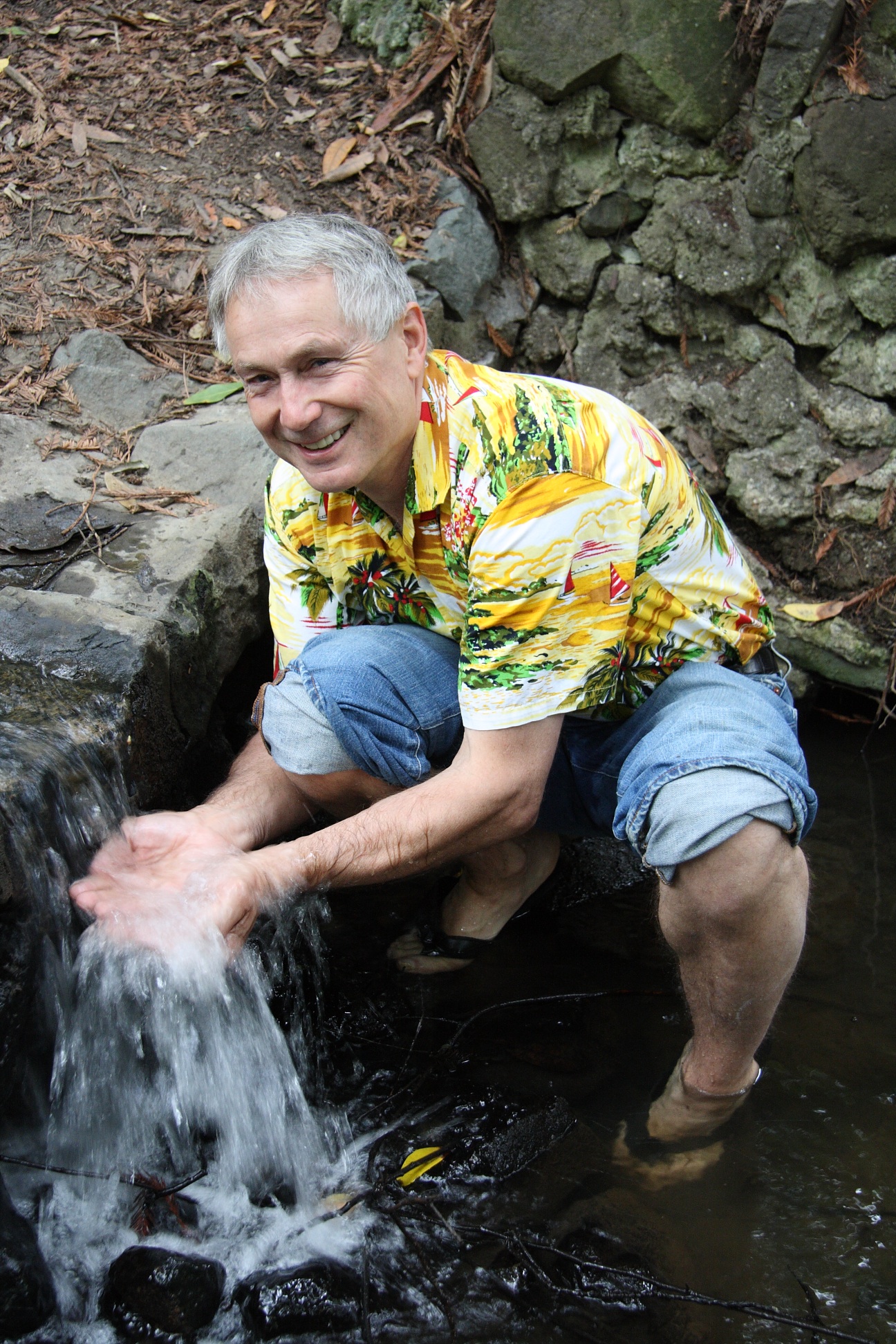
Berkeley Lab’s Rich Saykally has spent much of his career investigating the amazing chemistry of water.
“The XAS spectrum is generally sensitive to the changes in the local solvation environment around each atom, including potential effects of ion-pairing,” Saykally says. “However, the chemical information that one can extract from such experimental data alone is limited, so we interpret our spectra with a combination of molecular dynamics simulations and a first principles theory method.”
Development of this first principles theory method was led by Prendergast, a staff scientist in the Theory of Nanostructures Facility at Berkeley Lab’s Molecular Foundry. Computational resources were provided by the National Energy Research Scientific Computing Center (NERSC). The Molecular Foundry and NERSC, as well as the ALS, are all U.S. Department of Energy national user facilities hosted at Berkeley Lab.
With the liquid microjet technology, a sample rapidly flows through a fused silica capillary shaped to a finely tipped nozzle with an opening only a few micrometers in diameter. The resulting liquid beam travels a few centimeters in a vacuum chamber and is intersected by an X-ray beam then collected and condensed out. In analyzing their current results, which were obtained at ALS Beamline 8.0.1, the Berkeley Lab researchers concluded that the counterintuitive cation-cation pairing observed is driven by water-binding energy, as predicted by theory.
Orion Shih, a recent graduate of Saykally’s research group, is the lead author of a paper describing this study in the Journal of Chemical Physics. The paper is titled “Cation-cation contact pairing in water: Guanidinium.” Saykally is the corresponding author. Other co-authors are Alice England, Gregory Dallinger, Jacob  Smith, Kaitlin Duffey, Ronald Cohen and Prendergast.
“We found that the guanidinium ions form strong donor hydrogen bonds in the plane of the molecule, but weak acceptor hydrogen bonds with the pi electrons orthogonal to the plane,” Shih says. “When fluctuations bring the solvated ions near each other, the van der Waals attraction between the pi electron clouds squeezes out the weakly held water molecules, which move into the bulk solution and form much stronger hydrogen bonds with other water molecules. This release of the weakly interacting water molecules results in contact pairing between the guanidinium cations. We believe our observations may set a general precedent in which like charges attract becomes a new paradigm for aqueous solutions.”

Tuesday, June 11, 2013

Bullock honored by Royal Society of Chemistry

Pacific Northwest National Laboratory News Release:

Bullock honored by Royal Society of Chemistry

June 11, 2013 Share This!
PNNL scientist recognized with international award for outstanding catalysis research
RICHLAND, Wash. – Morris Bullock, a Laboratory Fellow at the Department of Energy's Pacific Northwest National Laboratory and director of the Center for Molecular Electrocatalysis, a DOE Energy Frontier Research Center, was selected to receive the Royal Society of Chemistry's Homogeneous Catalysis Award. The organization presents the award every two years.
Bullock was recognized for his "seminal work on transition metal hydrides, his pioneering use of inexpensive metals for homogeneous catalysis and the development of a new programme on molecular electrocatalysis."
Catalysts speed up chemical reactions and are used to make a wide variety of industrial processes more efficient, including production of commercial chemical products, food processing, and energy production from alternate sources. Additionally, catalysts are used to improve fuel efficiency and reduce harmful emissions. Homogeneous catalysis focuses on using catalysts that are in the same liquid "phase" as the other substances.
Transition metal hydride catalysts have metals bonded to hydrogen. Replacing precious metals such as platinum with less expensive catalysts such as iron and nickel can result in both cost-savings and decreased environmental impacts. Additionally, the Center for Molecular Electrocatalysis is focused on developing a comprehensive understanding of how chemical and electrical energy is stored and utilized for applications in the development of non-fossil fuel sources.
As part of the award, Bullock has been invited to deliver a lecture at four universities within the United Kingdom between October 2013 and May 2014. The award, including a medal, certificate, and £2000 honorarium, will be presented at a symposium associated with one of the lectures.
Bullock joined PNNL in 2006 and has more than 110 publications overall during his career. He earned a bachelor's degree in chemistry in 1979 from the University of North Carolina at Chapel Hill and a doctorate in chemistry in 1983 from the University of Wisconsin-Madison.

The Royal Society of Chemistry is the largest organization in Europe for advancing the chemical sciences and is supported by a worldwide network of members and an international publishing business. Their activities include education, conferences, science policy and the promotion of chemistry to the public.

Thursday, May 30, 2013

Atom by Atom, Bond by Bond, a Chemical Reaction Caught in the Act

News Release:


Berkeley Lab scientists make the first-ever high-resolution images of a molecule as it breaks and reforms chemical bonds

MAY 30, 2013
Paul Preuss 510-486-6249  paul_preuss@lbl.gov
 84 


News Release
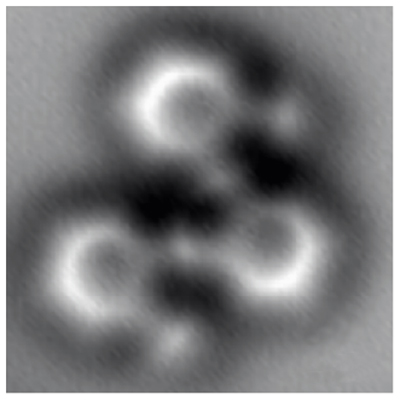
Almost as clearly as a textbook diagram, this image made by a noncontact atomic force microscope reveals individual atoms and bonds, in a molecule having 26 carbon atoms and 14 hydrogen atoms structured as three connected benzene rings.
Almost as clearly as a textbook diagram, this image made by a noncontact atomic force microscope reveals the positions of individual atoms and bonds, in a molecule having 26 carbon atoms and 14 hydrogen atoms structured as three connected benzene rings.
When Felix Fischer of the U.S. Department of Energy’s Lawrence Berkeley National Laboratory (Berkeley Lab) set out to develop nanostructures made of graphene using a new, controlled approach to chemical reactions, the first result was a surprise: spectacular images of individual carbon atoms and the bonds between them.
“We weren’t thinking about making beautiful images; the reactions themselves were the goal,” says Fischer, a staff scientist in Berkeley Lab’s Materials Sciences Division (MSD) and a professor of chemistry at the University of California, Berkeley. “But to really see what was happening at the single-atom level we had to use a uniquely sensitive atomic force microscope in Michael Crommie’s laboratory.” Crommie is an MSD scientist and a professor of physics at UC Berkeley.
What the microscope showed the researchers, says Fischer, “was amazing.” The specific outcomes of the reaction were themselves unexpected, but the visual evidence was even more so. “Nobody has ever taken direct, single-bond-resolved images of individual molecules, right before and immediately after a complex organic reaction,” Fischer says.
The researchers report their results online in the May 30, 2013 edition of Science Express.
Graphene nanostructures from the bottom up
Graphene nanostructures can form the transistors, logic gates, and other elements of exquisitely tiny electronic devices, but to become practical they will have to be mass produced with atomic precision. Hit-or-miss, top-down techniques, such as exfoliating graphite or unzipping carbon nanotubes, can’t do the job.
Fischer and his colleagues set out to engineer graphene nanostructures from the bottom up, by converting linear chains of carbon atoms into extended hexagonal sheets (polyaromatic hydrocarbons), using a reaction originally discovered by UC Berkeley professor Robert Bergman. The first requirement was to perform the reactions under controlled conditions.
“In solution, more than a dozen compounds could be the products of the reaction we were using, and characterizing the results would be difficult,” Fischer says. “Instead of a 3D solution we created a 2D system. We put our starting molecule” – a structure called oligo-enediyne, composed of three benzene rings linked by carbon atoms – “on a silver surface, and then induced reactions by heating it.”
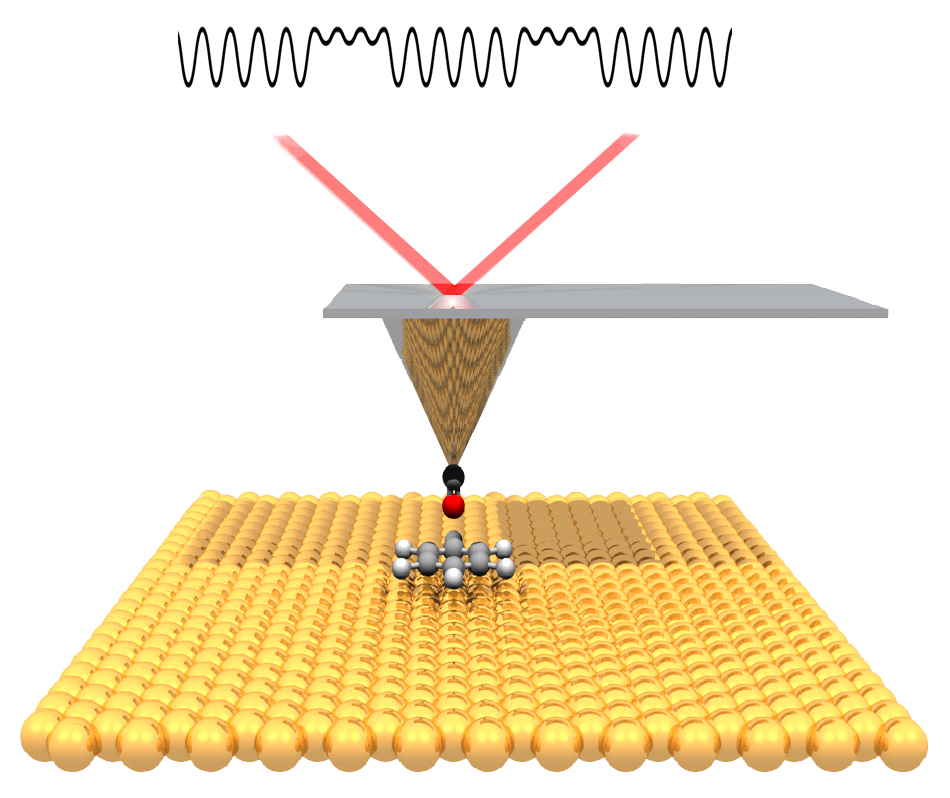
The single-atom tip of the noncontact atomic force microscope “feels” changes in the strength of electronic forces as it moves across the surface at a constant height. Resulting movements of the stylus are detected by a laser beam to compute images.
Fischer’s group collaborated with microscopy expert Crommie to devise the best possible view. The first attempt to track the reactions used a scanning tunneling microscope (STM), which senses electronic states when brought within a few billionths of a meter (nanometers) of the surface of the sample. But the image resolution of the tiny molecule and its products – each only about one nanometer across – wasn’t good enough to reliably identify the molecular structures.
The collaborators then turned to a technique called noncontact atomic force microscopy (nc-AFM), which probes the surface with a sharp tip. The tip is mechanically deflected by electronic forces very close to the sample, moving like a phonograph needle in a groove.
“A carbon monoxide molecule adsorbed onto the tip of the AFM ‘needle’ leaves a single oxygen atom as the probe,” Fischer explains. “Moving this ‘atomic finger’ back and forth over the silver surface is like reading Braille, as if we were feeling the small atomic-scale bumps made by the atoms.” Fischer notes that high-resolution AFM imaging was first performed by Gerhard Meyer’s group at IBM Zurich, “but here we are using it to understand the results of a fundamental chemical reaction.”
The single-atom moving finger of the nc-AFM could feel not only the individual atoms but the forces representing the bonds formed by the electrons shared between them. The resulting images bore a startling resemblance to diagrams from a textbook or on the blackboard, used to teach chemistry, except here no imagination is required.
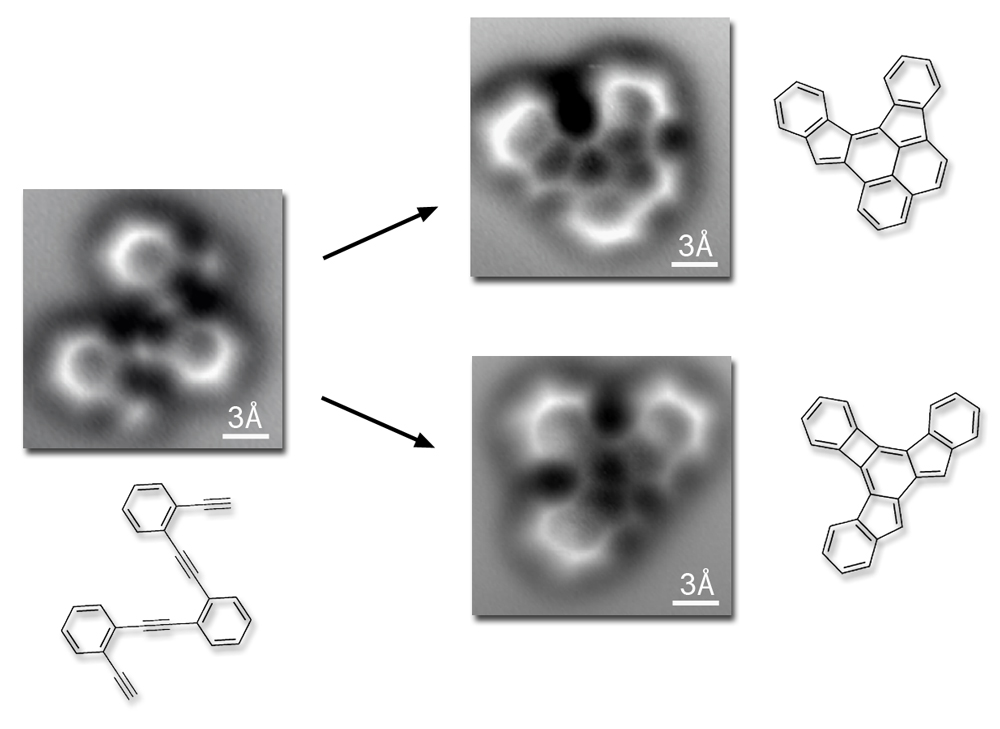
The original “reactant” molecule, resting on a flat silver surface, is imaged both before and after the reaction, which occurs when the temperature exceeds 90 degrees Celsius. The two most common final products of the reaction are shown. The three-angstrom scale bars (an angstrom is a ten-billionth of a meter) show that both reactant and products are about a billionth of a meter across.
The original reactant molecule, resting on a flat silver surface, is imaged both before and after the reaction, which occurs when the temperature exceeds 90 degrees Celsius. The two most common final products of the reaction are shown. The three-angstrom scale bars (an angstrom is a ten-billionth of a meter) indicate that both reactant and products are about a billionth of a meter across.
Says Fischer, “What you see is what you have – the effects of the electron forces among the atoms, and even the bond order. You can distinguish single, double, and triple bonds.”
A chemical bond is not as simple a concept as it may appear, however. From the dozens of possibilities, the starting molecule’s reaction did not yield what had intuitively seemed to Fischer and his colleagues the most likely products. Instead, the reaction produced two different molecules. The flat silver surface had rendered the reaction visible but also shaped it in unexpected ways.
The nc-AFM microscopy provided striking visual confirmation of the mechanisms that underlie these synthetic organic chemical reactions, and the unexpected results reinforced the promise of this powerful new method for building advanced nanoscale electronic devices from the bottom up.
Before much more complex graphitic nanostructures can result from this unique approach, says Fischer, “Large discoveries lie ahead.”
This work was supported by the Office of Naval Research, the U.S. Department of Energy’s Office of Science, the National Science Foundation, and the European Research Council.
###
“Direct Imaging of Covalent Bond Structure in Single-Molecule Chemical Reactions,” by Dimas G. de Oteyza, Patrick Gorman, Yen-Chia Chen, Sebastian Wickenburg, Alexander Riss, Duncan J. Mowbray, Grisha Etkin, Zahra Pedramrazi, Hsin-Zon Tsai, Angel Rubio, Michael F. Crommie, and Felix R. Fischer, will appear in Science and is now available on Science Express,http://www.sciencemag.org/content/early/2013/05/29/science.1238187.abstract.
For more information see the UC Berkeley release athttp://newscenter.berkeley.edu/2013/05/30/scientists-capture-first-images-of-molecules-before-and-after-reaction.
Lawrence Berkeley National Laboratory addresses the world’s most urgent scientific challenges by advancing sustainable energy, protecting human health, creating new materials, and revealing the origin and fate of the universe. Founded in 1931, Berkeley Lab’s scientific expertise has been recognized with 13 Nobel prizes. The University of California manages Berkeley Lab for the U.S. Department of Energy’s Office of Science. For more, visit http://www.lbl.gov.
DOE’s Office of Science is the single largest supporter of basic research in the physical sciences in the United States, and is working to address some of the most pressing challenges of our time. For more information, please visit the Office of Science website atscience.energy.gov.