Search This Blog

Showing posts with label Advanced Light Source. Show all posts

Wednesday, September 18, 2013

In Water as In Love, Likes Can Attract


Golfsmith.com


SEPTEMBER 18, 2013
Lynn Yarris (510) 486-5375  lcyarris@lbl.gov
 0 


Science Short
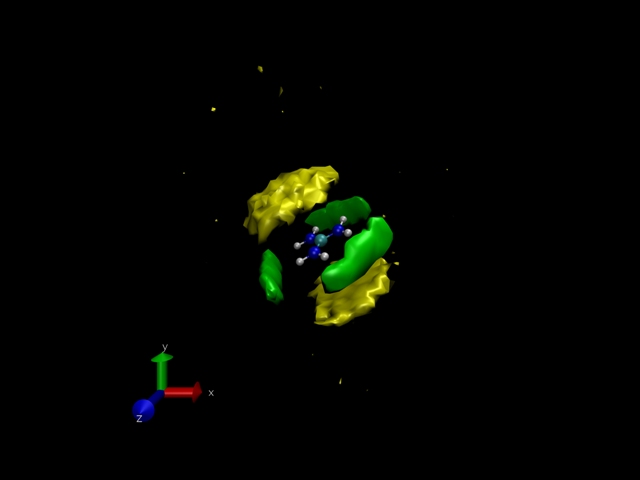
This model of the guanidinium chloride salt in solution shows  carbon (yellow) and water (green) surrounding the cations and  demonstrates cation-cation pairing.
This model of the guanidinium chloride salt (blue and silver) in solution shows carbon (yellow) and water (green) surrounding the cations and demonstrates cation-cation pairing.
At some point in elementary school you were shown that opposite charges attract and like charges repel. This is a universal scientific truth – except when it isn’t. A research team led by Berkeley Lab chemist Richard Saykally and theorist David Prendergast, working at the Advanced Light Source (ALS), has shown that, when hydrated in water, positively charged ions (cations) can actually pair up with one another.
“Through a combination of X-ray spectroscopy, liquid microjets and first principles’ theory, we’ve observed and characterized contact pairing between guanidinium cations in aqueous solution,” Saykally says. “Theorists have predicted this cation-to-cation pairing but it has never been definitively observed before. If guanidinium cations can pair this way, then other similar cation systems probably can too.”
Guanidinium is an ionic compound of hydrogen, nitrogen and carbon atoms whose salt – guanidinium chloride – is widely used by scientists to denature proteins for protein-folding studies. This practice dates back to the late 19th century when the Czech scientist Franz Hofmeister observed that cations such as guanidinium can pair with anions (negatively charged ions) in proteins to cause them to precipitate. The Hofmeister effect, which ranks ions on their ability to “salt-out” proteins, became a staple of protein research even though its mechanism has never been fully understood.
In 2006, Kim Collins of the University of Maryland proposed a “Law of Matching Water Affinities” to help explain “Hofmeister effects”. Collins’s proposal holds that the tendency of a cation and anion to form a contact pair is governed by how closely their hydration energies match, meaning how strongly the ions hold onto molecules of water. Saykally, who is a faculty scientist in Berkeley Lab’s Chemical Sciences Division and a professor of chemistry at the University of California Berkeley, devised a means of studying both the Law of Matching Water Affinities and Hofmeister effects. In 2000, he and his group incorporated liquid microjet technology into the high-vacuum experimental environment of ALS beamlines and used the combination to perform the first X-ray absorption spectroscopy measurements on liquid samples. This technique has since become a widely used research practice.
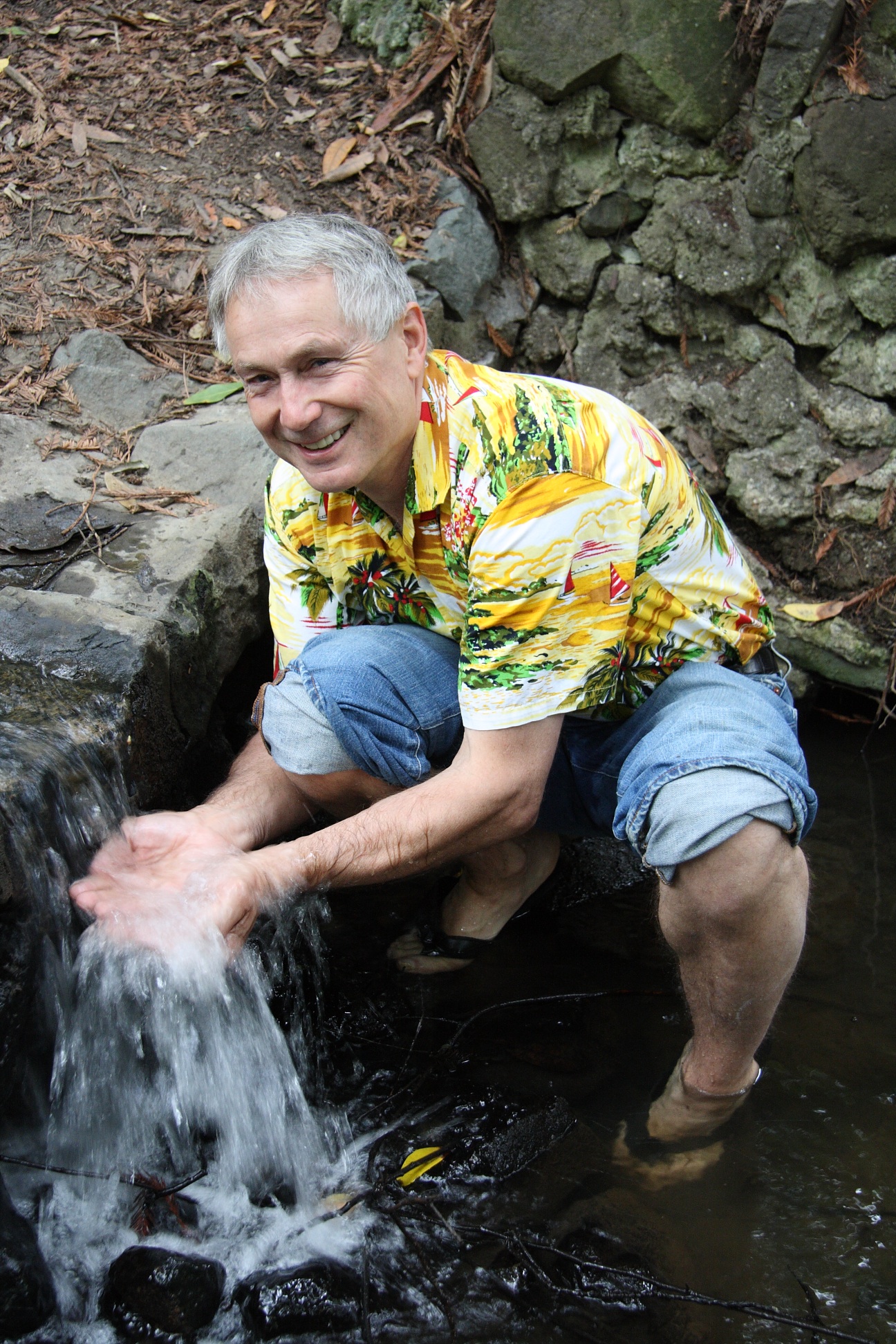
Berkeley Lab’s Rich Saykally has spent much of his career investigating the amazing chemistry of water.
“The XAS spectrum is generally sensitive to the changes in the local solvation environment around each atom, including potential effects of ion-pairing,” Saykally says. “However, the chemical information that one can extract from such experimental data alone is limited, so we interpret our spectra with a combination of molecular dynamics simulations and a first principles theory method.”
Development of this first principles theory method was led by Prendergast, a staff scientist in the Theory of Nanostructures Facility at Berkeley Lab’s Molecular Foundry. Computational resources were provided by the National Energy Research Scientific Computing Center (NERSC). The Molecular Foundry and NERSC, as well as the ALS, are all U.S. Department of Energy national user facilities hosted at Berkeley Lab.
With the liquid microjet technology, a sample rapidly flows through a fused silica capillary shaped to a finely tipped nozzle with an opening only a few micrometers in diameter. The resulting liquid beam travels a few centimeters in a vacuum chamber and is intersected by an X-ray beam then collected and condensed out. In analyzing their current results, which were obtained at ALS Beamline 8.0.1, the Berkeley Lab researchers concluded that the counterintuitive cation-cation pairing observed is driven by water-binding energy, as predicted by theory.
Orion Shih, a recent graduate of Saykally’s research group, is the lead author of a paper describing this study in the Journal of Chemical Physics. The paper is titled “Cation-cation contact pairing in water: Guanidinium.” Saykally is the corresponding author. Other co-authors are Alice England, Gregory Dallinger, Jacob  Smith, Kaitlin Duffey, Ronald Cohen and Prendergast.
“We found that the guanidinium ions form strong donor hydrogen bonds in the plane of the molecule, but weak acceptor hydrogen bonds with the pi electrons orthogonal to the plane,” Shih says. “When fluctuations bring the solvated ions near each other, the van der Waals attraction between the pi electron clouds squeezes out the weakly held water molecules, which move into the bulk solution and form much stronger hydrogen bonds with other water molecules. This release of the weakly interacting water molecules results in contact pairing between the guanidinium cations. We believe our observations may set a general precedent in which like charges attract becomes a new paradigm for aqueous solutions.”

Tuesday, June 11, 2013

Spin-Resolved ARPES Envisaged for the Advanced Light Source

News Release:

JUNE 11, 2013
Paul Preuss 510-486-6249  paul_preuss@lbl.gov
 0 


Science Short


A spin-ARPES detector specially designed for full-time use at the Advanced Light Source would augment angle-resolved photoemission spectroscopy by efficiently measuring the spin of low-energy electrons, via scattering from targets which could include such far-out materials as ultrathin magnetic films peppered with quantum wells and draped in graphene.
A spin-ARPES detector specially designed for the Advanced Light Source would augment angle-resolved photoemission spectroscopy by efficiently measuring the spin of low-energy electrons, scattered from targets which could include such far-out materials as ultrathin magnetic films peppered with quantum wells and draped in graphene.
One of the world’s brightest sources of soft x-rays, Berkeley Lab’s Advanced Light Source (ALS) is a premier facility for studying the properties of materials. It’s no surprise that ALS beamlines excel at ARPES – angle-resolved photoemission spectroscopy – a fundamental technique for examining electronic structure. When x-ray photons strike the surface of a sample, electrons are emitted (photoemitted), whose angular distribution and kinetic energy directly map the material’s electronic states.
In two fields fast coming to the fore, traditional ARPES is no longer sufficient to meet researchers’ needs. Magnetism, known since ancient times, has acquired new urgency with demands for faster computers and denser memories. Spintronics is the new kid on the block; scientific progress and venture capital alike ride on the promise of future energy-efficient spintronic nanogadgets.
Spin is common to both fields. Electron spin determines magnetic properties and can control how charged currents flow. The latest rage in materials science, topological insulators (TIs), are an extreme example, insulators on the inside but good conductors on the surface – where the electron spin and momentum of fast-moving surface electrons are locked together.
More knowledge about magnetism and spintronics requires new experimental tools: spin-resolved ARPES at the ALS.
“Spin-resolved photoemission is an old technique, but it’s slow, never easy, and requires high-energy electron beams,” says Alexei Fedorov, beamline scientist for ALS beamline 12.0.1. “Brookhaven’s National Synchrotron Light Source (NSLS) has the only beamline in the U.S. that can do spin-resolved photoemission, and it will be shut down soon to build NSLS-II.”
Recently ALS scientist Chris Jozwiak worked with ALS Division Deputy Director Zahid Hussain, Alessandra Lanzara of UC Berkeley, and others to fashion a spin time-of-flight analyzer – enabling spin-resolved ARPES with enhanced efficiency thanks to a spin detector that scatters low-energy electrons from magnetic surfaces. However, it requires wider pulse spacing than normal ALS operations; it can only use the bright and tunable ALS x‑rays during infrequent “two-bunch” operations, and otherwise must use a laboratory laser.
Fedorov, Jozwiak, and Hussain joined Peter Fischer of the Materials Sciences Division, an expert in soft x-ray microscopy of magnetic materials, to propose a spin-ARPES detector specially designed for full-time use at the Advanced Light Source. It won’t need high-energy electrons but will measure spin more efficiently via scattering from a variety of thin-film targets – perhaps including such far-out materials as ultrathin magnetic films peppered with quantum wells and draped in graphene.
surface-electrons
On the surface of a topological insulator an electron's direction determines its spin orientation and vice versa.
A beamline centered on spin-ARPES would offer a wide range of photon energies and excellent energy resolution, a tight focus, and full control of x-ray polarization. With direct sensitivity to spin, it would probe key electronic properties including valence band structure, core electron states, and the spin-dependent scattering of quasiparticles. The spin dependence of electron mobility is linked to a material’s spin-dependent band structure, and spin-ARPES is the only technique with such direct access. The new instrument will affect whole emerging fields, including topological insulators and photo-induced magnetism.