Search This Blog

Showing posts with label education. Show all posts

Friday, August 23, 2013

USDA and the HACU National Internship Program: A Recipe for Success


Save 20% on AVG Anti-Virus 2013 - 1 user 1 year


USDA Blog Post:

AMS Commodity Procurement Financial Analyst Keven Valentin, a former HACU intern at work. Valentin was an intern with AMS for two years through the HACU National Internship Program. Photo Courtesy of Hakim Fobia, AMS Public Affairs
Reach one, teach one. That is the approach that USDA has taken in its partnership with the Hispanic Association of Colleges and Universities (HACU) National Internship Program. As a current employee with the USDA’s Agricultural Marketing Service (AMS) and a former HACU intern, I am glad to help continue this tradition.
The HACU National Internship Program helps talented students in more than 400 colleges and universities gain valuable experience through paid internships at federal, private, and non-profit organizations. USDA has been a leading organization working with the program, hosting nearly 1900 HACU student interns since 1994. I am part of the nearly 46% of former HACU interns who earned the opportunity to stay on board with the federal government after finishing my degree.
I accepted the opportunity to continue my career at the USDA after two eventful summers interning with the AMS Commodity Procurement Program. During my tenure as an intern, I applied what I learned in my education and work experience. My time was spent helping develop and implement a new budget tracking system, overlooking a $2.6 million budget, developing budget procedures, and providing support to the daily branch operations. I also got a chance to help develop and implement a new invoicing process using the new Web Based Supply Chain Management System (WBSCM). The WBSCM is now used by AMS to make purchases for the National School Lunch Program and other federal nutrition assistance programs.
As I look back on my experience as a HACU intern working at AMS, I really appreciate the way the program works with USDA and other organizations. After applying for the program through my school, the University of Puerto Rico at Aguadilla Campus, HACU placed me in an organization and position that matched my educational background. Working with the Commodity Procurement staff turned out to be a great fit for me.
AMS Administrator Anne Alonzo with students at the 2013 HACU National Internship Program summer farewell event. Photo courtesy of Karen Comfort, AMS Special Assistant to the Administrator
Looking to the future, I am confident that other HACU interns will have similar experiences at USDA and other partner organizations. I recently had the pleasure of attending the 2013 HACU National Internship Program summer farewell event where AMS Administrator Anne Alonzo inspired all. She gave the keynote address alongside Principal Deputy Under Secretary for the Department of Veterans Affairs Robert L. Jesse. It was great to hear Administrator Alonzo encourage the interns to be fearless as they carve out their career paths. She also stressed that they can achieve anything when they are passionate about the fields they choose.
I am glad to hear that my office will be welcoming two talented HACU interns this fall. I am excited to be able to share with them my positive experiences and encourage them to tell others about the program’s success with AMS and other USDA agencies. I know that the internship will place them on track for long, fruitful careers and that they will help others follow in their footsteps.

Tuesday, August 20, 2013

The Foundation is in the STEM


Jeep Parts and Accessories


USDA Blog Post:

This post is part of the Science Today feature series on the USDA blog. Check back each week as we showcase stories and news from USDA’s rich science and research portfolio.
When I look at tree leaves, the stems always strike me as remarkable.  Although typically slender, they’re pretty resilient, firmly anchoring the leaves to the branches to withstand the extreme whims of Mother Nature.
In the same way that stems provide a sturdy foundation so that the leaves can make food for the tree, science, technology, engineering, and math (frequently referred to as STEM) education provides a strong base for a wide range of activities.
The recent report on agricultural preparedness by the President’s Council of Advisors on Science and Technology detailed a critical need for graduates in STEM fields.  For many people, myself included, interest in STEM starts as an innate curiosity, refined over time with more specific guidance and instruction.
In high school, I dabbled with courses in agricultural science and horticulture, biology and chemistry, physics and calculus.  When my senior independent study aquaculture project went horribly wrong and all of my trout ended up in Davy Jones’ locker, I learned firsthand that sometimes research doesn’t turn out the way you plan it—but that’s OK.  Success or failure, every experiment is a learning opportunity.  And by the time I graduated, I was hooked on science and eager to continue my STEM education in college.
I finished college with degrees in agricultural education, animal science, and environmental science.   My coursework ran the gamut from statistics and research methods to biochemistry, nutrition, and physiology.  The diverse background prepared me well for a job at USDA.  From food security to bioenergy, STEM-related issues are at the crux of the Research, Education, and Economics mission area.  On a daily basis, I draw upon the knowledge and skills gained from my STEM courses.
Even as a parent, my STEM background makes it easier to field my sons’ countless questions.  I can explain why grass is green, how plants use water, what happens when a seed pops through the soil. I’m thrilled to be able to cultivate and nourish my boys’ curiosity and hope that it leads to their pursuit of STEM degrees.
Editors Note: Do you have questions about why you should study STEM subjects?  Ever wondered about the career possibilities of agriculture science degrees?
Join us for an important Twitter chat and tweet in your questions and comments throughout the event.  Please use the #studyagscience hashtag in all of your tweets. You can tweet questions, comments, or just follow along. See you Friday at 2 pm ET!

Monday, August 19, 2013

From Mentee to Mentor, Berkeley Lab's Education Programs Inspire Scientists


Jeep Parts and Accessories


AUGUST 19, 2013
Julie Chao (510) 486-6491  JHChao@lbl.gov 
Feature
Question: “What did you do this summer?” Answer: “I built the Advanced Light Source.”
It’s the rare undergraduate who can say they spent their vacation building a third-generation synchrotron, but that’s exactly what Seno Rekawa did in the summer of 1991 as an intern at Lawrence Berkeley National Laboratory. It was an auspicious start to his career. Less than five years later, he was working as a full-time engineer at Berkeley Lab and now is a regular mentor to budding high school and college engineers.
Berkeley Lab’s Center for Science and Engineering Education (CSEE), with its range of internship offerings, helps to fulfill one of the Lab’s mandates, which is to inspire and prepare this country’s next generation of scientists, engineers and technicians. This year more than 70 current and recent college students and almost 20 high school and college instructors participated in a CSEE program, working with Berkeley Lab researchers on science projects spanning from cancer research to cosmology to biofuels.
singer-torok
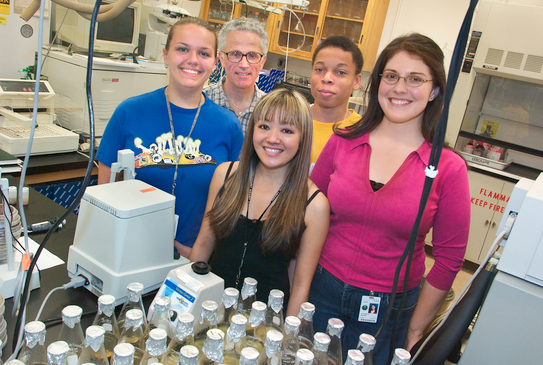
Mary Singer (far right) as an intern in 2004 in the microbiology lab of Tamas Torok (second from left). (Photo credits: Roy Kaltschmidt/Berkeley Lab)
While not all interns go on to pursue careers in science, their CSEE experiences are often pivotal to their eventual career choices. And in the case of Rekawa and a handful of other participants such as Mary Singer, their Berkeley Lab internship not only launched their science careers, they have now come full circle and are mentoring students themselves.
Singer was a biology major at the University of Texas at Austin about 10 years ago when she did an internship in the laboratory of Berkeley Lab scientist Tamas Torok of the Earth Sciences Division. “He trained us on general microbiology techniques, doing hands-on things. He was a great mentor,” Singer said. “My experience was really enriched specifically by his involvement.”
The following year, after graduating, she returned to Berkeley Lab for a second internship because she was still undecided on graduate school. After that summer, she was hired on staff as a research associate. “This is my first job after college,” she said. “I’m basically the lab manager now, and I really love it.”
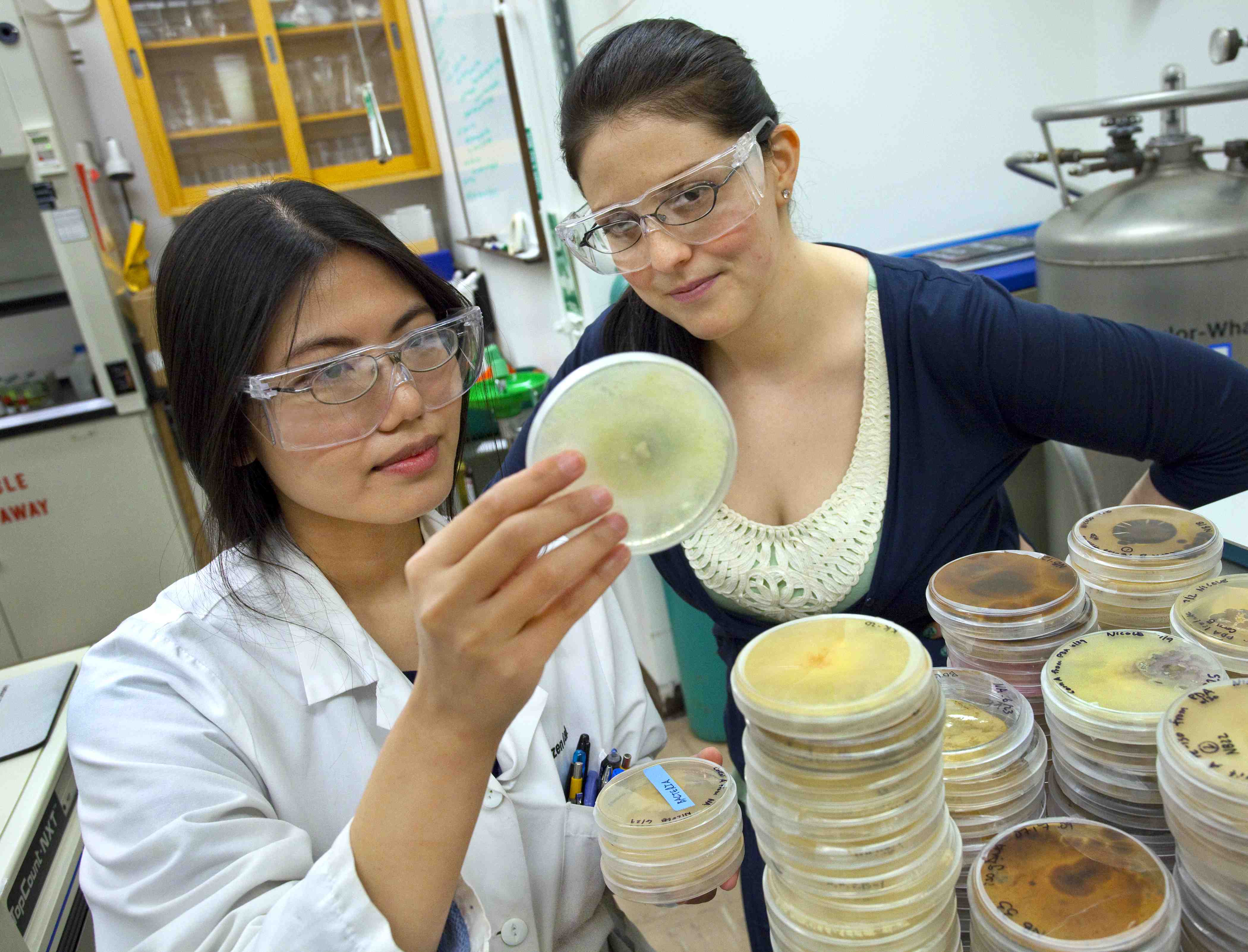
Singer mentoring a student in 2010.
She has collected environmental samples from throughout the Bay Area for a bioprospecting project and traveled to the country of Georgia last year for training in bacteriaphage virology. From Torok she has learned not only about microbiology but what it takes to be a good mentor. “He’s not the kind of mentor who will just give you an assignment and send you off,” she said. “He is very much involved. There are no stupid questions. He just really cares.”
With Torok as an example, Singer now mentors students herself. “There are a lot of guests, students and collaborators from other countries coming to our lab,” she said. “Tamas has passed many of the students onto me—we show them the ropes, give them that exposure. It helps people decide, do I want go to grad school, or do I not want to do this anymore?”
For Singer, the answer is clear: “I see this as my longterm career. I don’t see the need for grad school particularly as I really enjoy what I’m doing.”
Rekawa, who is originally from Sri Lanka but grew up in the Bay Area, was going to Diablo Valley College when he did his first internship at Berkeley Lab. With about 10 other undergrads and mentors from the Accelerator and Fusion Research Division, they spent the summer building the storage ring components of the Advanced Light Source, one of the world’s brightest sources of ultraviolet and soft x-ray beams.
“It was very helpful. It gave me the hands-on experience I was looking for,” he said. “I was studying engineering, but this gave me the confidence to take the mechanical engineering path.”
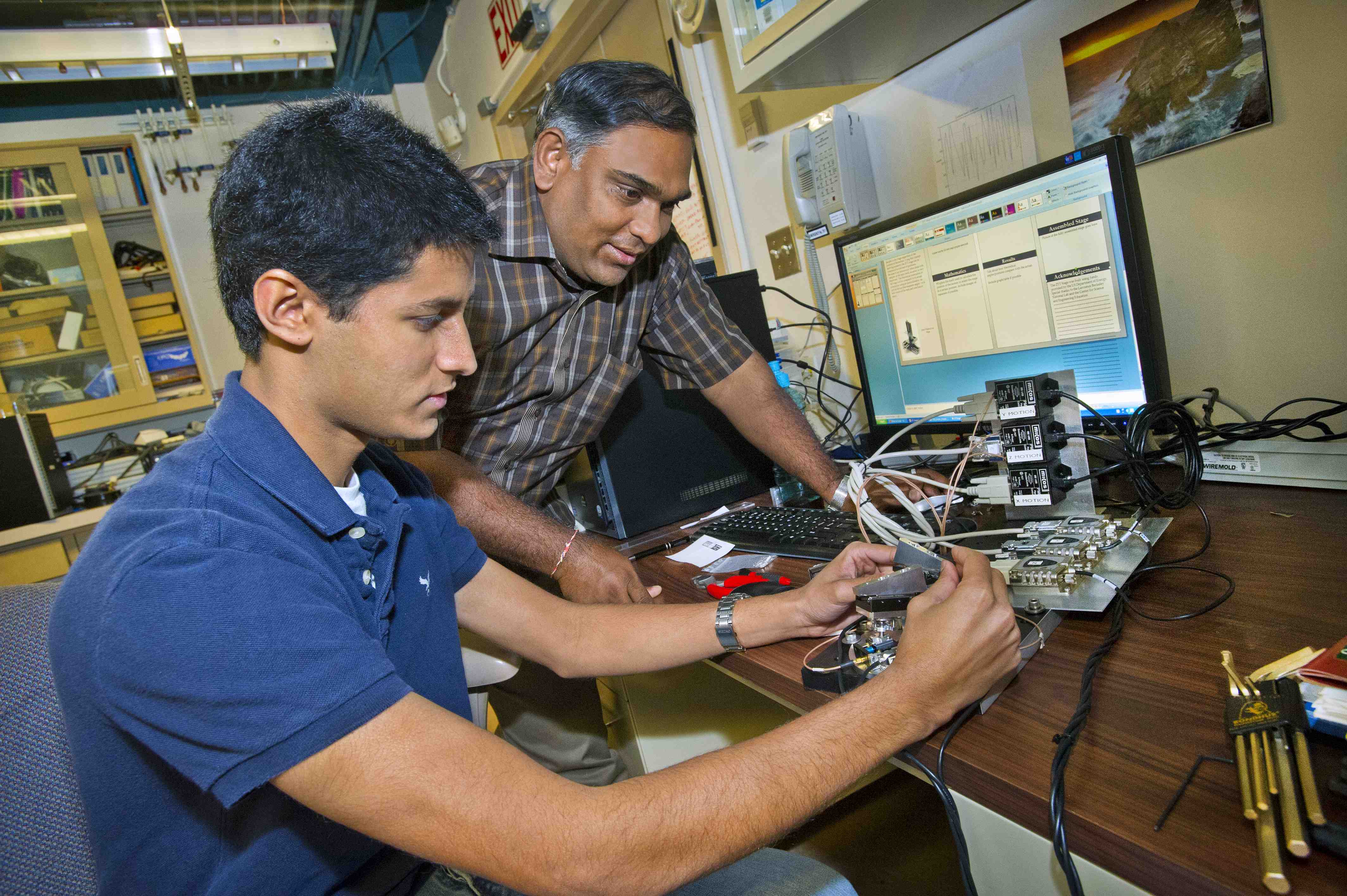
Seno Rekawa mentors a student as part of Berkeley Lab's summer CSEE program.
Seno Rekawa (right) mentors a student as part of Berkeley Lab's summer CSEE program.
He came back the following summer, then kept getting invited back year after year. Along the way he completed his engineering degree at the University of Wisconsin and had started a masters program when Berkeley Lab came calling again, this time with an offer from the Center for X-Ray Optics (CXRO), which develops instruments and techniques in extreme ultraviolet lithography, optics and nanoengineering. Rekawa couldn’t say no. “At the time there were no jobs available,” he said. “Even people with PhDs were having trouble finding jobs.”
Now he’s the chief engineer for CXRO, with seven engineers reporting to him. The work is cutting edge. “It’s very rewarding,” he said. “Almost every time, we’re making something nobody else in the world has built before. We’re always one or two steps ahead of industry.”
But in addition to contributing to world-class science and technology, Rekawa is also passionate about mentoring students. “I want to give them the same experience that I went through,” he said. “A lot of the students that come in here are really trying to figure out where they want to go, what they want to study. Sometimes you see strengths and weaknesses in somebody that they might not know about. You can guide them, or throw problems at them to see where they excel. By doing that they also get confidence.”
“I’m always very supportive of mentoring programs,” he continued. “It’s a lot of work from our side, but a lot of us in our group, from the scientific staff all the way to the machinists, encourage kids to come here, get their hands dirty. Sometimes we can actually mold them to be engineers.”
# # #
Lawrence Berkeley National Laboratory addresses the world’s most urgent scientific challenges by advancing sustainable energy, protecting human health, creating new materials, and revealing the origin and fate of the universe. Founded in 1931, Berkeley Lab’s scientific expertise has been recognized with 13 Nobel prizes. The University of California manages Berkeley Lab for the U.S. Department of Energy’s Office of Science. For more, visit www.lbl.gov.