Search This Blog

Showing posts with label USDA. Show all posts

Tuesday, October 20, 2015

How Can We Support Affordable, Nutritious Diets? Reduce Wasted Food

From the #USDA:


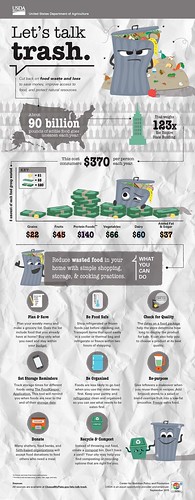
Let's Talk Trash infographic
“Let’s Talk Trash” raises awareness about food waste and provides tips to help consumers reduce food waste at home. (Click to enlarge)
Looking for a way to stretch your food dollars?  Would an extra $30 per month for each person in your household help?  That’s about $370 per person per year, or almost $1,500 for a family of four.  That’s the amount of money USDA estimates the average American spends on food that’s not eaten.  It is the equivalent of approximately 2 months’ worth of groceries in a year. 
Reducing food loss and waste is an important part of maximizing household budgets. USDA has initiated a number of projects to help consumers reduce wasted food and improve overall nutrition.  Most recently, USDA’s Center for Nutrition Policy and Promotion (CNPP) launched a new section on ChooseMyPlate.gov to raise awareness about how much edible food is wasted nationwide, along with a range of resources supporting food waste reduction efforts, including a new infographic titled “Let’s Talk Trash. There are also tips on ways to reduce food waste at home.
Since the launch of MyPlate in 2011, ChooseMyPlate.gov has become a popular resource for consumers seeking information on nutrition, with more than 51 million visitors to the web site since 2011. Facts about food waste and loss, as well as tips to help consumers reduce waste, are valuable additions to ChooseMyPlate.gov as USDA strives to educate consumers about achieving affordable, nutritious diets.
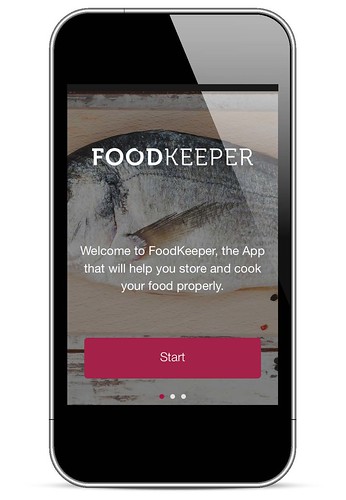
FoodKeeper app
FoodKeeper app provides information about how to store food safely.
Sometimes consumers throw away wholesome food because they are confused about how to safely store it or the meaning of dates stamped on the label.  USDA’s Food Safety and Inspection Service (FSIS) works to inform consumers about the importance of safe food storage as a means of reducing the risk of foodborne illness.  As part of its food waste reduction outreach, FSIS recently updated the safe-storage and date-labeling information on their website.  In spring 2015, USDA also launched (in partnership with the Food Marketing Institute and Cornell University) a FoodKeeper App to provide consumers with easy access to clear, scientific information on food storage, proper storage temperatures, food product dating, and expiration dates.
To help educate children about nutritious diets and food waste, USDA’s Food and Nutrition Service (FNS) has initiated programs in the National School Lunch Program and School Breakfast Program to promote waste reduction.  FNS offers strategies to help schools reduce food waste by scheduling recess before lunch, extending the lunch period, and creating lunch lines conducive to healthful, waste-free meal choices.  Schools are also encouraged to set up food share tables and donate wholesome, excess school food to local hunger relief organizations.  In 2014, FNS created an infographic titled, “Reducing Food Waste – What Schools Can Do Today.”  The infographic explains the issue of wasted food and offers a few simple strategies to help schools reduce food waste.
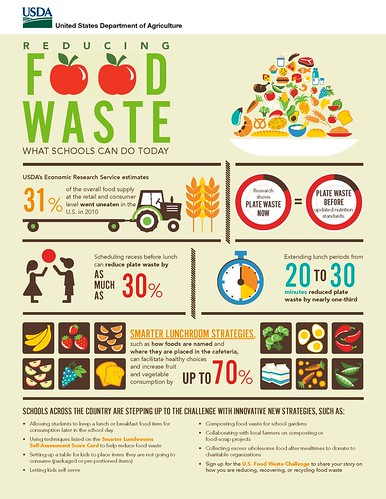
Reducing Food Waste Infographic
“Reducing Food Waste – What Schools Can Do Today” offers strategies to help schools reduce food waste. (Click to enlarge)
On September 16, 2015, Agriculture Secretary Tom Vilsack and Environmental Protection Agency Deputy Administrator Stan Meiburg announced the United States’ first-ever national food waste reduction goal, calling for a 50-percent reduction by 2030. As part of this effort, the federal government will lead a new partnership with charitable organizations, faith-based organizations, the private sector and local, state and tribal governments to reduce food loss and waste in order to improve food security and conserve our nation’s natural resources.
    

Wisconsin Team Nutrition's Whipping Up Wellness, Wisconsin Student Chef Competition

From the #USDA:


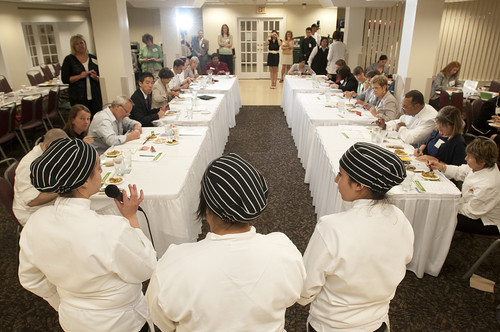
Fresh fruits and vegetables in a high school cafeteria
Fresh fruits and vegetables in a high school cafeteria.
The Team Nutrition Training Grants are awarded as part of USDA’s Team Nutrition initiative, which provides resources, training, and nutrition education lessons for schools and child care providers. And this year marks the 20th anniversary of the Team Nutrition initiative.  Wisconsin Team Nutrition has used the funding to build out their healthy cooking contest for the states’ middle and high school students.
By Kelly Williams, RDN, CD, and Alicia Dill, RDN, CD, CDE; Wisconsin Department of Public Instruction, School Nutrition Team
Thanks to funding from a USDA Team Nutrition Training Grant, Wisconsin Team Nutrition has been able to expand its interactive cooking contest, Whipping Up Wellness, Wisconsin Student Chef Competition. Now in its third year, this popular contest combines the excitement of competition with the principles of healthy eating, while creating an engaging opportunity for nutrition education.
The competition targets Wisconsin middle and high school students. To compete, students must form a team of three to five students. Once formed, students participate in the first round of competition, a recipe contest.
For the recipe contest, student teams create and submit a healthy recipe to our panel of judges. The recipes are then scored based on their nutritional quality, culinary skills, presentation, and creativity. To add a twist to this round, we have previously asked teams to meet special standards such as incorporating locally grown foods, Wisconsin dairy products, and items similar to those available through the USDA Foods program.
The top five teams are invited to participate in the second round, the cooking competition. During this round, students prepare their recipes and plate their completed dishes in the state-of-the-art food lab at the University of Wisconsin-Madison. Teams deliver their dish and conduct a 10-minute presentation on the development of their recipe, the appeal of their recipe, and the results of their school taste test. Judges score the final dishes on taste, appearance, originality, student appeal, and overall presentation, and at the end of the competition, winners are announced.
Over its three year history, Whipping Up Wellness, Wisconsin Student Chef Competition has become immensely popular. The number of students participating in the contest has more than tripled, and our student teams have wowed the judges with incredible dishes such as Baked Italian Pasta, Savory Wild Rice Quiche, and Butternut Squash Lasagna.
The winning dishes, along with other qualifying recipes, have been compiled into a Whipping Up Wellness Cookbook. To view, please visit the Wisconsin Team Nutrition website.
    

Sunday, October 18, 2015

Colorado Team Nutrition Makes School Wellness a Success

From the #USDA:


Two kids writing on paper
As part of their wellness training, CDE educated 111 participants on local school wellness policies and how to include students in their wellness activities.
The following guest blog describes how one state education department used a USDA Team Nutrition grant to develop training to help schools implement programs that promote student wellness and to meet updated meal standards.
By Heather Hauswirth, RD, Program Specialist, Office of School Nutrition, Colorado Department of Education  
In September 2014, our office, the Colorado Department of Education Office of School Nutrition, was awarded a Team Nutrition Training Grant from the USDA Food and Nutrition Service to implement statewide school wellness training.
Local educational agencies (LEAs) that participate in the National School Lunch Program or other federal child nutrition programs are required to establish school wellness policies for all schools under their jurisdiction. These policies are an important tool for parents, LEAs and school districts in promoting student wellness, preventing and reducing childhood obesity, and ensuring that school meal nutrition guidelines meet the minimum federal school meal standards.
School wellness has always been a priority for Colorado and for our office, and we wanted to expand our training efforts and incorporate recent regulations, such as “smart snacks” requirements. We did this by collaborating with the Colorado Education Initiative (CEI), a statewide nonprofit organization, to develop a training curriculum that addressed the needs of all Colorado schools. The training built on the wellness activities CEI had conducted and incorporated feedback from a statewide needs assessment.
The training addressed a number of topics, including:
  • The nuts and bolts of the federal regulations;
  • The updated criteria for the HealthierUS School Challenge: Smarter Lunchroom (HUSSC: SL) awards (a voluntary certification initiative from USDA); and
  • Ways to use “smarter lunchroom” strategies in Colorado school cafeterias
Our aim was to ensure that all Colorado schools were meeting the federal requirements and encouraging schools to apply for the HUSSC: SL awards.
In March and April 2015, we trained 111 participants, including school food service personnel, school health professionals, school administrators, physical education teachers, and parents.
The feedback we received from participants was overwhelmingly positive:
  • 96 percent of respondents had a better understanding of local school wellness policy requirements;
  • 97 percent of respondents said they had learned strategies for implementing “smart snacks”;
  • 98 percent of respondents agreed they had learned “smarter lunchroom” strategies;
  • 83 percent of respondents agreed to implement “smarter lunchroom” strategies into their schools;
  • 94 percent of respondents better understood the HUSSC: SL award criteria; and
  • 66 percent of respondents planned to apply for one or more HUSSC: SL awards.
Additionally, in June and July 2015, we sent out a three-month follow-up survey to check in with participants and determine the impact of our trainings. We are currently analyzing these results, and plan to use the feedback to refine the training.
As for the 2015-2016 school year, we are knee-deep in planning and promoting four upcoming wellness trainings. Given the enormous success of our previous trainings, we anticipate these upcoming events will fill up quickly!
For more information on local school wellness policies and resources, check out the Team Nutrition Web site at: http://www.fns.usda.gov/tn/local-school-wellness-policy
For more information on Colorado Team Nutrition activities, go to:  http://www.cde.state.co.us/nutrition/nutritngrant
    

Friday, October 16, 2015

Tales from a School Food Service Director: It's all about the Brand

From the #USDA:


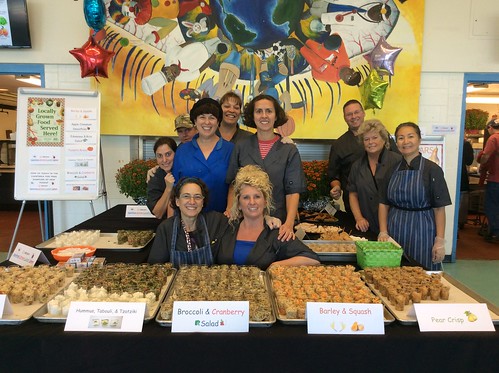
Andover High School's school meal staff serving up food samples
Andover High School's school meal staff serving up samples of their nutritious and delicious foods.
This guest blog showcases the success story of a school food service director in an upper-class suburb of Boston.  The director discusses some of the creative methods her school meal program uses to boost participation and, thereby, promote health and nutrition in their district.
By Gail Koutroubas, School Food Service Director in Andover, MA
For 10 years, I’ve been a school food service director at Andover School District in Massachusetts.  My district of 5,900 students lies in an upper-class suburb of Boston. The median income is approximately $140,000 with just 7 percent of students qualifying for free or reduced-priced lunch.
Some would think this is a good situation – students are generally well-nourished outside of school and can afford to purchase food while at school. But believe it or not, being a school food director in a more affluent area comes with its own set of challenges. Mainly, how do I get students who can afford to bring junk food from home to choose healthy, well-balanced meals offered through our school meals program?
When I started, school meal participation was at just 20 percent districtwide. We needed a way to increase participation while still meeting both the updated federal standards and Massachusetts’ strict state a la carte regulations. It was time to get creative. We made a number of changes that helped increase participation including bundling snacks to create reimbursable meals, working with local vendors, and implementing a breakfast program and an afterschool snack program. Today, participation is up to 52 percent!
We currently have relationships with six local vendors that serve foods the students already know and love. We work with these vendors to purchase healthy items that meet the nutrition standards.  For example, we get whole grain bagels from Perfectos, a local bagel shop. We bundle it with a house-made smoothie made with low-fat/fat-free yogurt, carrot sticks, a piece of fresh fruit, and milk. This combination creates a reimbursable meal that we offer to high school and middle school students.  This meal – loaded with protein, calcium, fresh fruits and vegetables – is one of our most popular, mainly because kids identify with the brand.
Back in the 1990s, schools brought in products from vendors like Pizza Hut or McDonald’s to boost participation. We’re using a similar technique to draw students to school meals, but only now, we’re supporting local vendors and serving students healthy options: It’s a WIN-WIN!
    

Next Steps for Team Up for School Nutrition Success

From the #USDA:


Teams sharing menu planning alternatives during training
Teams share menu planning alternatives during training.
Over the past year, USDA’s Food and Nutrition Service partnered with the Institute for Child Nutrition (ICN) to host seven regional workshops called Team Up for School Nutrition Success.  The two day, face-to-face workshops used a research-based mentorship model to educate and empower school nutrition professionals around the country. Each training was tailored to the specific needs of that region. Topics included everything from menu planning to financial management and meal presentation. Participants shared challenges and solutions, identified program strengths, and developed action plans for implementing their new ideas.
Thanks to the Team Up for School Nutrition Success training, the participants reported they can now:
“Breathe easy.  I can now say I have people who will help guide me in the right direction.” – Cheryl Bowers, Courtland, VA.
“Feel good about what I’m doing and what I want to do.  [I can] go back and work on my goals.  I will be successful.” – Bruce Davis, Farmville VA.
“Communicate better with my superiors on what this department clearly needs. I have defined goals and a clearer view. I’m also aware that many districts share my struggles – so I’m not alone.” – Kerry Y. Billner, San Jose, CA.
More than 650 people attended the seven trainings, not to mention the more than 4,700 that participated in the corresponding webinars each month. Across the board, the feedback received from attendees was overwhelmingly positive. They walked away with valuable knowledge that they would be able to put to use immediately. For example, Charlotte Davis from Arkansas shared:
 “Having the panelists talk about increasing participation and menu planning was really helpful to me because it’s easy to get stuck in a rut and you want to do new things so that gave me a lot of new ideas to take back to my staff to see how much of this we can use.”
Another attendee, Katherine Alexander from Vermont, stated:
“I really appreciated the peer mentoring model, especially the intentional method… In each of my small groups I had the opportunity to hone my skills.”
For many one of the most beneficial parts of the workshops was the opportunity to network with other school nutrition professionals like themselves.  Margret Farris from Washington exclaimed:
“I can’t wait to email mentors and others I have met at the conference. I had no training – no one to call – I was ‘professionally isolated’ this past year.  I now have a family to ask and answer questions, give and receive support.”
Texan Shelly Copeland added:
“One of the things I’m taking away from here is the relationships we’re establishing because we do depend on each other for ideas.  No one is re-inventing wheels, we’re all learning things that other people are doing.  Even if we can’t do things exactly how they’re doing them in other school districts, we can tweak them and make them work for us.”
The Team Up coordinators are thrilled to hear and see the impact these trainings have already had on the participants, their schools districts, and the students.  To continue that momentum, USDA is excited to announce that we’re extending the Team Up for School Nutrition Success program!  Next week, USDA and ICN will host a Team Up consultant orientation to train approximately 40 consultants on how to facilitate a Team Up for School Nutrition Success workshop. These consultants could then be hired by state agencies and regional offices to facilitate additional workshops. Then, on November 17, we’ll hold a “train the trainer” session for up to 100 state agency representatives so they can take Team Up back to their own state.  Together, these trainings will make Team Up for School Nutrition Success a long-term sustainable training program and will prepare for future expansion efforts.
For more information about the Team Up for School Nutrition Success initiative, check out these guest blogs authored by former participants in the Team Up workshops.  For more information on other training and resources available to school nutrition professionals, visit our Healthier School Day website.
    

Taste Fall Flavors with "Simply Soup" at the USDA Farmers Market at Night on Friday, October 16th

From the #USDA:


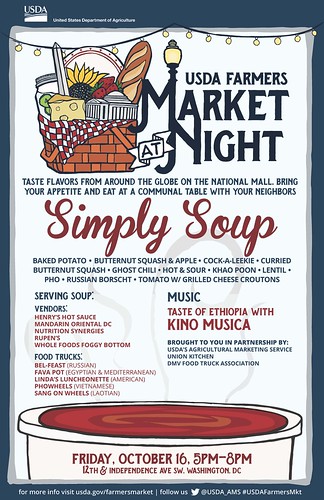
USDA Farmers Market at Night Simply Soup poster
Join us for the last USDA Farmers Market at Night this Friday, October 16, from 5 p.m. to 8 p.m.
There is nothing better than a warm bowl of soup in the fall. Our vendors are serving soups, stews, and chilis from all over the globe at the last USDA Farmers Market at Night this Friday, October 16, from 5 p.m. to 8 p.m.  From spicy Lao rice vermicelli soup to a Scottish soup dish of chicken and leeks, vendors will be serving cozy soups filled with fall favorites like apples, butternut squash, and chile peppers.  With more than 15 different choices, you will be challenged to find a favorite!
Check out our menu of soups being served:
Baked Potato
Bison Chili with Local Ale
Bone Broth (Chicken & Beef)
Butternut Squash & Apple
Cock-a-Leekie
Curried Butternut Squash
Curried Kabocha Pumpkin
Ghost Chili
Hot & Sour
Khao poon
Lentil
Pho
Russian Borscht
Tomato with Grilled Cheese Croutons
& more ….

This will be the last of the 6 night markets tested this season. Each has offered good food, lively music and a relaxing vibe to anyone working or living nearby. It’s been an excellent venue to experiment with different ideas, and we look forward to sharing our lessons learned from this pilot project. USDA Farmers Market at Night has featured different vendors than those at the day market allowing us to work with more local food businesses like members of DC food incubator Union Kitchen and the DMV Food Truck Association.
This month’s entertainment will be a Taste of Ethiopia with live music by Kino Musica. So, bring your “soupetite,” meet your neighbors, and enjoy a warm bowl of soup at a communal table in the USDA People’s Garden next to the Market at 12th and Independence Street, S.W. in Washington, D.C. 
USDA’s Agricultural Marketing Service (AMS) supports farmers markets in communities across the country through grants, research and technical assistance.  Both the day and night USDA Farmers Markets accept SNAP, WIC and Senior Farmers Market Nutrition Program (SFMNP) coupons. The markets distributed DC Produce Plus checks through September.
If you are not in the DC area, you can find a farmers market in your hometown or wherever you travel by visiting USDA’s Local Food Directories.  The directories are an easy, one-stop shop for information on local farmers markets, community-supported agriculture (CSA) enterprises, food hubs, and on-farm markets.  All of these initiatives contribute to USDA’s Know Your Farmer, Know Your Food (KYF2) initiative, which coordinates efforts across USDA to support local and regional food systems.
For more details, follow us on Twitter @USDA_AMS.  Look for the #USDAFarmersMkt hashtag for updates about both the day and night markets or visit us online at www.usda.gov/farmersmarket.
    

Friday, March 28, 2014

Healthy Lunchtime Challenge Recipe Contest

USDA Blog Post:

Young chefs prepare food with First Lady Michelle Obama and Secretary Vilsack.
Who will represent your state at the 3rd Annual White House Kids’ State Dinner?  It could be your child showing off his or her creativity and culinary talents in front of the First Lady and people from around the country.  First Lady Michelle Obama, the USDA, the U.S. Department of Education, and Epicurious have once again teamed up for the third annual Healthy Lunchtime Challenge recipe contest.
Children ages 8 – 12 years old are invited to submit an original lunch recipe inspired by MyPlate. Young chefs can win the chance to attend the Kids’ “State Dinner” hosted by First Lady Michelle Obama at the White House in Washington, D.C.  The invited guests will include the Lunchtime Challenge winners and their parents from every state!
Kids and their parents know that eating a healthy lunch is critical to making the grade at school, but it takes a little imagination to create something delicious and nutritious.  Ask the kids in your life to share a healthy recipe and inspire others.  Recipes should be:
  • Healthy – Veggies and fruits should make up half of your recipe, and be sure to also include low-fat dairy, whole grains, and lean protein
  • Delicious – Keep it fresh, simple, and yummy
  • Original – We want your own creative dish, not one from a published source
  • Affordable – No fancy ingredients needed
  • Meaningful – Tell us the story of how you came to make this dish
Young chefs can be role models for their peers, their families, and all Americans.  To learn more about this amazing opportunity and to enter the Healthy Lunchtime Challenge, visit: http://www.recipechallenge.epicurious.com/. Entries must be received by April 5, 2014 for a chance to win!
Spread the word!  You and your child could win a trip to Washington, D.C. and represent your state at the Kids’ State Dinner at the White House.

Friday, August 23, 2013

Innovative Education and Public Safety through USDA Funding


Save 20% on AVG Anti-Virus 2013 - 1 user 1 year


USDA Blog Post:

Bear Creek Community Charter School in Bear Creek Township recently received USDA Rural Development Community Facility Loan funding to construct a new charter school to provide innovative education opportunities for K-8th grade. Photo is an interior architectural rendering of the central commons courtesy of Hemmler and Camayd Architects. USDA photo.
Bear Creek Community Charter School has a history dating back to Civil War Brigadier General Paul Ambrose Oliver whose heirs donated the land for the school in 1929.  The original Oliver School was a traditional one-room school house, constructed as a project of the Works Progress Administration (instituted by presidential executive order under the Emergency Relief Appropriation Act of April 1935, to generate public jobs for the unemployed).
Currently, Bear Creek Community Charter School operates out of the original school and additional outdated school buildings along a busy highway. Intended for an enrollment of 240, the expanding school now has an enrollment of over 400 with a waiting list of over 100. USDA Rural Development recently announced Community Facilities Program Loan funding of almost $12 million for the construction of a new two-story 63,000 sq. ft. public charter school building. The new school will meet the demand for innovative educational opportunities, including environmental education. Ecology and environmental science is woven into the academic fabric of the school, and each student receives dedicated instructional time specific for environmental education. Students engage in hands-on learning opportunities, participate in field-work (work outdoors), and actively participate in school-wide environmental leadership opportunities. Located on a 97-acre tract, the preliminary plans for the school grounds include an outdoor classroom, interpretive trail, rain gardens, educational stations, and soccer and softball fields. Construction is expected to be completed by the summer of 2015.
(center) Thomas Williams, USDA Rural Development Pennsylvania State Director; Michael Lombardo, Pittston City Councilman;  Bob Morgan, District Director, Congressman Matthew A. Cartwright’s office;  Joe Moskovitz, Pittston City Administrator and youth from the Pittston Perspective Church proudly pose with the new Pittston City police vehicle. USDA Photo.
(center) Thomas Williams, USDA Rural Development Pennsylvania State Director; Michael Lombardo, Pittston City Councilman; Bob Morgan, District Director, Congressman Matthew A. Cartwright’s office; Joe Moskovitz, Pittston City Administrator and youth from the Pittston Perspective Church proudly pose with the new Pittston City police vehicle. USDA Photo.
In addition to the new school funding in Luzerne County, USDA also recently granted funds for the purchase of a K-9 police vehicle in Pittston City through the Community Facilities Grant Program. The newly purchased police vehicle is equipped with a harness to transport a K-9 who is currently in training.
The projects provide a significant benefit to rural Luzerne County. The school is providing innovative educational opportunities for young families and the police vehicle is addressing public safety in a city that is in the midst of a downtown revitalization project.
Officials who attended the recent funding announcement at the existing Bear Creek Community Charter School included (L to R) Bill Goldsworthy, Assistant Director, PA Governor Thomas Corbett’s Northeast Regional Office; Walter Mitchell, Mayor, Bear Creek Village Borough; William Harner, Acting Pennsylvania Secretary of Education; Gia Stoddard, Bear Creek Community Charter School Student; Thomas Williams, USDA Rural Development Pennsylvania State Director; Congressman Matthew A. Cartwright; Jim Smith, Chief Executive Officer, Bear Creek Community Charter School. USDA photo.

Friday, August 9, 2013

USDA Partners With Service Organizations to Help Veterans Find Careers in Agriculture


Gravity Defyer, Comfort Shoes


USDA Blog Post:

Veterans returning home from overseas tours-of-duty face many challenges as they readjust to civilian life, and one of the most daunting ones is finding employment. Last year, a new program — the Soldiers to Civilians (S2C) Project — was started in rural west Tennessee to give local veterans the training and skills they need to enter into the field of precision agriculture. Thanks to grant assistance from the Department of Agriculture (USDA), project leaders will now be able to expand the S2C program beyond west Tennessee to help even more veterans living in the rural delta areas of east Arkansas and west Mississippi.
The expansion was funded, in part, through USDA’s Rural Business Enterprise Grant (RBEG) program, which promotes development of small and emerging businesses in rural areas. Rural Business-Cooperative Service Administrator Lillian Salerno announced the award during a visit to the Memphis Bioworks Foundation, a bioscience-oriented nonprofit organization that is a partner on the S2C project. Memphis Bioworks is one of more than 130 projects in 30 states and the Commonwealth of Puerto Rico that are receiving RBEG funds.
The S2C project to train veterans for precision agriculture jobs was the idea of Tennessee’s Crockett Policy Institute. Memphis Bioworks has teamed with the Institute on the S2C project and it is receiving a USDA grant that will enable S2C to expand into 110 counties.
Precision agriculture uses sophisticated equipment like GPS, satellite imagery and other computer technology to help farmers manage their crops. Veterans are excellent candidates for this type of work because their military training exposes them to similar technology systems. “Today, veterans are computer-savvy and used to operating very advanced systems,” noted Bill Stubblefield, director of Memphis Bioworks’ AgBioworks Regional Initiative, at the event.
According to Salerno, the RBEG program finances a broad range of business projects. Since the beginning of the Obama Administration, the RBEG program has helped create or save more than 73,000 rural jobs, provided over $170.9 million in economic development assistance, improved manufacturing capability, and expanded health care and educational facilities, and has either expanded or helped establish almost 41,070 rural businesses and community projects.
Learn more about the Rural Business Enterprise Grant program, and other USDA programs that support rural business development, at www.rurdev.usda.gov.

Thursday, August 8, 2013

USDA Serving Montana Ranchers, Farmers


DAZ Studio 4 - Create 3D Art for Free


Ben Hofer, Rockport Colony Secretary, with a Kangal. NWRC researchers are studying the potential of these livestock guard animals for use where large predators include wolves and grizzly bear. The Kangal breed is gentle and trustworthy with their people or animals, but if the need arises they can become very protective. (USDA Photo by Under Secretary Edward Avalos)
USDA plays an important and vital role in supporting rural communities throughout the country.  On my recent trip to Montana, I saw firsthand how the work, services and programs provided by the Animal and Plant Health Inspection Service (APHIS), Farm Service Agency (FSA) and Natural Resources Conservation Service (NRCS) directly impact stakeholder day-to-day operations.
After a listening session in Cut Bank, I was invited to the Rockport Colony, by Ben Hofer, the Secretary for the Hutterite community near Pendroy, Montana.  This impressive communal farming/ranching operation includes sheep, cattle, hog and poultry production, a dairy, and meat-processing facility, as well as fruit, vegetable, and grain production.  I quickly learned USDA is an important partner, providing support for water lines, fencing, and wildlife damage management.
Mr. Hofer explained how APHIS Wildlife Services helps reduce the colony’s livestock depredation:   “Our colony was losing seven to eight sheep every night.  At the time we were seriously considering getting out of the sheep business because we could not sustain losing ewes every night.  Wildlife Services saved our sheep business.”
In addition to removing some predators, Mr. Hofer said, “Wildlife Services has assisted us to build electrified pens to put our sheep into at night to protect them from wolves and grizzly bears.  They have placed livestock guard dogs on our colony to study how dogs can help protect our sheep and cattle.”
At Rockport, Wildlife Services’ National Wildlife Research Center is studying the potential for using a Turkish guard dog in areas with large carnivores.  The Kangal, an early Mastiff-type breed, can grow to 34 inches and 145 pounds.  Typical, smaller livestock protection dogs sometimes are no match for wolves and grizzly bears.
As grizzly populations recover, they are returning to their natural range on the prairie.  Wildlife Services has assisted the Rockport Colony with building round pens for sheep to reduce losses during grizzly attacks.  It has also captured depredating bears, as authorized by management agencies, and turned them over to the state wildlife agency for relocation or removal.
At USDA we are continuously looking for improvement, efficiencies, and other methods for doing our job.  A good example is the work underway by Wildlife Services and NWRC to use nonlethal methods to reduce depredation.  My Montana visit was a welcome opportunity to hear from Tribal and faith-based communities, along with others, on how USDA can and is helping feed America.